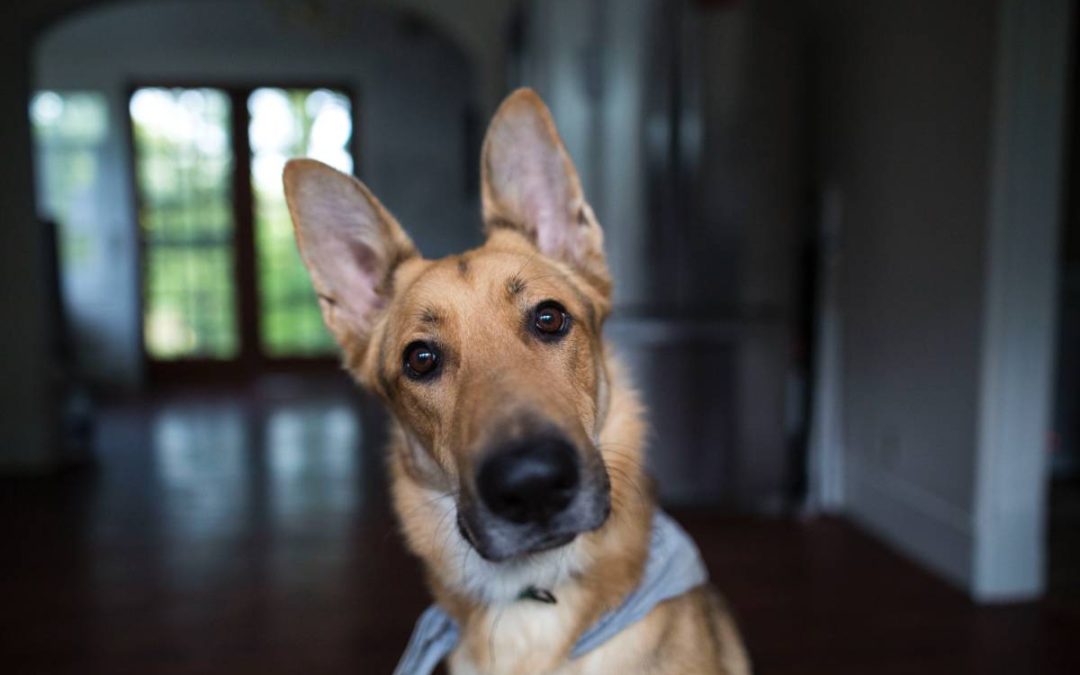
What does noise anxiety look like? It’s like when your dog hears thunder, starts barking and trembling; clinging to you like a magnet until the noise goes away.  Noise anxiety, also known as noise aversion, can be caused by tons of different noises from something as common as a doorbell to the occasional crack of fireworks.

An estimated 2 out of 3 dogs in the United States are affected by noise anxiety.   Did you know this is a medical condition that can and should be treated?  It’s important to understand that dogs experiencing noise aversion are similar to a person having an anxiety attack.

When left untreated, noise aversion likely worsens and can progress to fear of multiple types of noises, possibly leading to destructive behavior.

Why does this happen?

Some breeds of dogs are naturally predisposed to noise aversion.  This happens most often with herding dogs as well as some working dogs.

A traumatic or stressful event can cause a dog to become nervous around different sounds.  Poor socialization and maternal stress during pregnancy are also factors that could cause noise anxiety.

Signs of noise aversion can include:

  • Lip licking
  • Yawning
  • Lifting a forelimb
  • Whining or barking
  • Freezing
  • Panting
  • Hiding
  • Trembling
  • Pacing
  • Trying to escape 
  • Attention seeking or unusual clinginess
  • Inappropriate elimination

Noises that trigger anxiety can include:

  • Thunder
  • Fireworks
  • Sirens and other street noises
  • Indoor or outdoor construction
  • Doorbells
  • Lawn mowers and/or other yard tools
  • Vacuum cleaners
  • Garbage trucks or snow plows
  • Sporting events on tv or at a local stadium
  • Smoke detectors
  • Electronic noises (i.e. microwave or cell phone)

What are some possible treatments?

Once a pet is diagnosed with noise aversion, treatment typically includes a combination of environmental management, behavior modification, and medication.  

Changing their environment:

In order to manage their environment, it is recommended you create a safe space for your dog to get away from the noise.   A few ideas for environmental management include closing the blinds, playing music or turning on the television, moving to an inner room with better isolation from outside sounds, or distraction by playing with their favorite toy.   While our natural instinct may be to coddle or console the dog when it’s afraid, this added drama exacerbates the situation.

Behavior modification:

Using positive reinforcement, such as a food treat, to encourage positive emotional responses to sounds that induce fear can help modify their behavior.  This type of training should be done under the direction of a veterinarian or qualified animal behaviorist.  If done incorrectly, it can result in an increase of fear and anxiety.

Therapeutic products and medications:

Natural pheromone products, such as Adaptil Calm, can be beneficial.  These products contain a dog-appeasing pheromone that provides a strong signal of security and comfort.  There are also wraps and anxiety shirts that have become increasingly popular.  These wearable products are based on the belief that applying consistent pressure to certain parts of the body helps trigger a rest and relaxation response.

For many dogs, prescription medications are most effective in treating noise anxiety. There are several different types of prescription medications that can be administered. Your veterinarian will determine if a medication with a rapid onset of action that lasts for a few hours will suffice, or if medications that have a more long acting effect will work better.  

Take your answers to this quiz to your veterinarian to help them determine the best course of action.   Click here to begin.

Whether your dog suffers from noise anxiety continuously or just a couple times a year, it is important to seek treatment to help end the suffering.  Available treatments not only improve your dog’s quality of life, but can also give you peace of mind to know you have the proper tools to help when these anxious situations occur.

Does your dog suffer from noise anxiety?  We’d love to hear about your experience with any treatments, products, medications, etc.


Cats may never be without curiosity for very long, because it’s a major part of who they are, and their survival instincts are closely tied to it.  Sometimes their inquisitive personalities get the best of them. Unfortunately, the beautiful bouquet of Easter Lilies on your kitchen table or the colorful bundle of daylilies in your garden are a safety threat for your cat.  In fact, lilies are lethally toxic to cats.

WARNING:  If you think your cat has ingested a lily plant, this is a life-threatening emergency. Seek veterinary care immediately and have your veterinarian contact an animal poison control center.

Cats can suffer fatal kidney failure just from biting into a lily leaf or petal, licking the pollen from its paws, or even drinking water from a vase containing cut lilies.  

If you have a cat, the safest bet is to keep the following plants out of your home.

  • Asiatic lily
  • Day lily
  • Easter lily
  • Peace lily
  • Japanese Show lily
  • Rubrum lily
  • Stargazer lily
  • Tiger lily
  • Wood lily
  • Lily of the Valley

What are the signs of lily toxicity?

Within the first two hours, you may notice a loss of appetite, low energy level, and vomiting. Later in the disease process, seizures may occur and prolonged exposure will result in dehydration, renal failure, and death if left untreated. 

  • Lethargy
  • Loss of Appetite
  • Vomiting
  • Tremors
  • Seizures
  • Dehydration
  • Renal Failure
  • Death

Time is crucial.  The earlier you seek treatment for your cat, the better their chance for survival.  If you should find a chewed on piece of the plant or pieces of the plant in vomit, be sure to take your cat to the veterinarian immediately.


I’m sure you’ve heard the saying “curiosity killed the cat”.  Unfortunately, for many dog owners “curiosity skunked the dog”.   These naturally curious canines oftentimes can’t resist getting into trouble.   When they do get skunked it is an unpleasant experience for everyone involved.  

Follow the steps below to get rid of the smell quickly and effectively.

First, assess the situation:

Check your pet’s eyes.  If they are red or irritated, take your dog to the veterinarian as skunk spray can potentially cause damage to the cornea.

If they are acting normally, keep your dog outside and act fast.  As the skunk spray dries it becomes more difficult to remove.

Second, make homemade skunk shampoo:

Mix together:

  • 1 quart of 3% hydrogen peroxide 
  • ¼ cup of baking soda
  • 2 teaspoons of liquid dish detergent

CAUTION:  Do NOT get the solution in their eyes or mouth.  Do NOT store this mixture or make it ahead of time, as the mixture could explode if left in a bottle.

Third, how to remove the skunk smell:

You will want to wash your pet outdoors and use an old towel to dry them.  Scrub your dog with this solution and make sure to get all the way down to the skin.  If the face is involved, use a washcloth to carefully wash this area, and be sure to avoid the eyes and mouth.

*Do not let the dog soak for too long, as peroxide can discolor their coat (especially if the fur is dark brown or black). 

Last, rinse and repeat:

Rinse and repeat this process until the smell dissipates.  After the oils have been removed follow up with your pet’s regular shampoo, rinsing the coat thoroughly all the way down to the skin.  

Things you should know about skunks:

  • They can spray up to 15 feet away
  • They are not aggressive or dangerous and mean no harm to your pet
  • They cannot spray again for 10 days
  • They are most active in the evenings
  • They breed during mid-February to late March and are out and about during this time

Unfortunately, any de-skunking process may not completely rid the pet of the skunk odor, no matter how thoroughly you scrubbed or how quickly you attended to the clean up. Especially if your pet got sprayed in the face, which is a tough spot to de-skunk.  Be proactive and keep an eye out for skunks, especially after dark during warm weather.

Has your dog ever been skunked?  

If so, please comment with any successful treatment!


PetSnoot receives zero compensation for these reviews and the opinions provided are solely based on personal experiences with these products.

Oxbow Essentials Adult Guinea Pig Food:

My first experience with Oxbow Animal Health products was during my time managing a veterinary practice that specialized in exotics and pocket pets.  Oxbow was our go-to brand for food, treats, and hay for rabbits and pocket pets.  

When my husband and I decided to surprise our kids with guinea pigs one Christmas, there was no question which brand of food I would purchase.  I’ve been feeding our guinea pigs Oxbow Essentials – Adult Guinea Pig Food and Western Timothy Hay since day one and they love it.  

Oxbow also offers a wide selection of enrichment toys.   Some of their favorites are Timothy Pops, Hay Bundles, Apple Sticks, and their Timothy Hide and Seek Mat.  

*What is the purpose of enrichment?  

The goal of enrichment is to encourage your guinea pig to interact with items in their environment which allow them to demonstrate their species-specific behaviors, giving them an opportunity for exercise, and enhancing their well-being.

Why I love this brand:

They have a high level of quality assurance to make sure only the best products enter the market.  In addition to being passionate about nutritional formulas for healthy digestion and to help small mammals thrive, they provide grant funding and emergency support to assist animal rescues, humane societies, wildlife rehabilitation centers, and many other organizations in need.  

Their wide range of products is readily available at most pet stores and online at Chewy and other popular pet retail sites.  

What would I change about this product:

Honestly, I can’t think of anything I would change.  I appreciate having a reputable brand readily available that I can feel confident feeding to my pets!  

Learn more about guinea pig care here.

Click here to visit the Oxbow Animal Health website.

Choosing the right veterinarian is one of the most important decisions you will make for your pets.  It’s not always an easy decision to make.  As a veterinary technician with well over 25 years of experience in the veterinary industry, I’m here to help!

What should you consider when looking at your options?  The list below includes options you may not know are available to you, as well as things you may not have thought to consider.  My goal is for you to feel confident and content with whichever practice you choose. 

Pricing

Why is this the first thing listed?  When it comes down to it, we are all curious about the price of any item or service. I’m sure you’ve heard the saying “you get what you pay for.”  It goes without saying this applies to veterinary clinic pricing as well.  

Realistically, we need to know the cost of some preventative services in order to plan ahead, save money, and know what to expect with yearly veterinary care.  For these reasons, being knowledgeable about pricing before selecting a clinic is important, but making a decision based strictly on who is the cheapest shouldn’t be the goal.  Many clinics have similar pricing, but there are reasons why clinics differ in price.

Click here to find a list of clinics in your area with preventative care price transparency. 

Click here to learn more about veterinary costs and the value in veterinary visits.

Fear Free Certified 

Did you know there are veterinary clinics that have a certification in a fear-free initiative?  Many pets experience anxiety during their veterinary visit.  Veterinary practices that are fear free certified have completed online and in-person education courses that promote methods and protocols that lead to the reduction or removal of anxiety triggers.  These protocols are designed to create an experience that is rewarding and safer for all involved.  

To find Fear Free Certified veterinary practices in your area, type Fear Free Certified in the search bar.

AAHA (American Animal Hospital Association) Certified

The American Animal Hospital Association (AAHA) sets the standard of excellence in veterinary medicine.  In order to become AAHA certified, a veterinary practice must meet the 940 standards and 18 categories covering all areas of veterinary practice – from anesthesia and pain management to recordkeeping and client communication.

AAHA has practice consultants that visit these veterinary hospitals regularly to confirm they uphold these standards of care.  AAHA also works closely with the AVMA (American Veterinary Medical Association) to develop preventive healthcare guidelines, such as vaccinations, testing for dangerous diseases, and more.

To find an AAHA certified veterinary practice in your area, type AAHA certified in the search bar.

Cat Friendly Practice (CFP)

These feline friendly practices must meet specific criteria and take extra steps to provide the best care and experience for you and your cat.  This program is awarded by the American Association of Feline Practitioners and is designed to elevate care and reduce stress for cats during their veterinary visit.

For example, many Cat Friendly Practices have a separate entrance and/or waiting area for felines as well as staff training on feline-friendly handling.   

To find cat friendly veterinary practice in your area, type cat friendly practice in the search bar.

Independently owned vs. Corporate owned

Did you know that out of the 30,000 veterinary practices in the US, at least 10 percent of general practices and 40 to 50 percent of specialty practices are owned by corporations?  Even more surprisingly, two of the largest veterinary practice chains, VCA (Veterinary Clinics of America) and Banfield, are owned by Mars, Inc.  Yes, the same company that owns brands such as Uncle Ben’s rice and Twix candy bars, also owns a large percentage of veterinary practices.

Is this a bad thing?  Not necessarily.  Veterinarians in corporate practice don’t have to deal with management, staffing issues, or business management, letting them focus solely on patient care.  Many corporate owned veterinary practices have board certified surgeons and equipment which allows them to offer more invasive surgeries and procedures.

Independently owned veterinary practices have more flexibility with treatment options and aren’t restricted in the ability to customize their approach in treating each patient.  While corporate owned practices must conform to standards of care set by the corporate headquarters, independently owned practices have flexibility with treatment options and freedom to customize treatment for each individual patient.

The primary goal of independently owned practices is to develop a relationship with the pet owner and to deliver the care they need.  Without the financial resources of a big corporation, a locally owned independent practice can use all of the support they can get.

Additional things to consider when finding the right veterinarian for your pet family are listed below.

  • How many veterinarians are in the practice?  Having multiple veterinarians on staff may be beneficial in case you need to schedule an appointment unexpectedly due to sudden illness or emergency.  If there is more than one veterinarian on duty, this may allow a bit more flexibility in scheduling.
  • How many years of experience does the veterinarian have?  Many clinics have a staff bio section on their website that gives details on experience, continuing education, and special interests for each veterinarian.
  • Does the practice offer behavior training?  Some veterinary practices host behavior training classes at their facility, which may be beneficial for pet owners with puppies that need training and socialization.  If you have a pet with specific behavior issues you may want to search for a clinic with a veterinary behaviorist.
  • Does the practice have modern equipment and technology?  Digital x-ray, ultrasound, laser therapy, and in house laboratory equipment are a few examples of modern equipment used to formulate a proper diagnosis.
  • What services are available?  Some veterinary clinics strictly practice preventative care such as wellness exams, vaccinations, spays and neuters, and maybe teeth cleanings.   Other practices offer more extensive surgical procedures such as orthopedic surgery, stem cell therapy, acupuncture, and more.  
  • Do they have an extensive in house pharmacy and do they offer online options for medication refills and prescription diets?  If you have a pet on several medications, it may be easier to order through a veterinary practice’s online pharmacy and have them shipped directly to your home.  It is also beneficial to have a veterinarian with an extensive in house pharmacy so you can leave your visit with any prescribed meds in hand.
  • Do they offer boarding or grooming services?  Many pet owners are more comfortable leaving their pet for boarding or grooming in a facility that has a veterinarian on site.  For example, if you have a diabetic pet, it may be beneficial to board them at a veterinary facility with trained staff that can monitor glucose levels and administer insulin as needed.
  • Do they have hours of availability that fit your schedule?  Some clinics offer walk in hours while others operate by appointment only.  Not all clinics operate every weekday and many have limited hours on the weekends.  There are some veterinary clinics that offer the option to drop your pet off for their appointment in the morning and pick them up later that day.  Be sure to check their schedule for hours during the week, on the weekends, and their appointment policies.
  • Do they see exotics and/or pocket pets?  Not all veterinarians have the expertise, equipment, and medications needed to treat exotics and pocket pets.  Each species is unique and requires specialized care and handling.  Keep in mind, some veterinarians will treat guinea pigs, hamsters, gerbils, and rabbits, but may not be equipped to treat reptiles or birds.  
  • Does your pet have a specific condition that needs continual treatment?    Some veterinarians specialize in specific types of medicine such as geriatrics, allergies, dentistry, surgery, and more.  Just like human doctors, there are veterinarians that are passionate about a specialty, have more experience treating these types of cases, and continually attend educational classes to keep up to date with the latest treatments for each specialty.  The PetSnoot Veterinary Resources page has made it easy for you to search for veterinarians with special interests.  For example, type dermatology or skin conditions in the search bar to find veterinarians that specialize in dermatology.

Thanks to the availability of high quality veterinary care, preventive care, and pet owner’s careful monitoring, pets are living longer, healthier lives.   Finding the right veterinary team for you and your pet family is sometimes easier said than done.  With so many factors to consider, it’s important to see the value in the services offered and choose a clinic that provides the best care at a price you are comfortable with.

No one wants their dog to get sick or feel bad!  When our pets get diarrhea or vomiting we want to “fix” the situation immediately.   In most cases, diarrhea is the body’s way of flushing out toxins and it is typically best to let it run its course.   If you know your dog may have eaten something like garbage or something poisonous, call your veterinarian or poison control immediately and do NOT give any over-the-counter medications.

What if your dog has diarrhea, but to your knowledge hasn’t eaten anything poisonous or abnormal?  If your dog does not have any underlying medical conditions and is otherwise healthy, read the information below to help get them on track.

Withhold food for approximately 24 hours. 

What goes in must come out.  Give their system a chance to flush out the toxins and settle down a bit before offering more food.  Always have fresh water available!

When your dog is ready to eat again, offer bland foods.

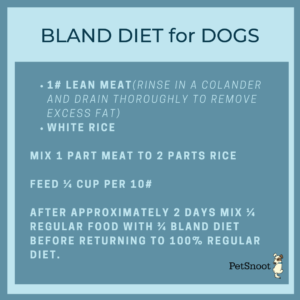
A bland diet such as boiled hamburger, skinless white meat chicken, and cooked white rice should be fed for approximately 2 days.  See the recipe below.

Keep them hydrated.

Diarrhea can rapidly deplete the body of essential fluids.  Keep a water bowl full of fresh water at all times and offer a separate bowl with Gatorade.

Exercise.

Believe it or not, walking 15 minutes twice a day will help stimulate a part of the nervous system that is responsible for keeping the gut calm.  Only attempt exercise if they have the energy for it!

Why can’t I just give my dog some Pepto Bismol?

Like aspirin, Pepto can increase blood serum levels of salicylate.   This leads to thinning of the blood and digestive tract irritation.  Too much Pepto can lead to salicylate poisoning which has serious effects such as coma, breathing difficulties, tremors, seizures, and internal bleeding.  

It is important that you don’t give Pepto if your dog has a bleeding disorder, stomach or intestinal ulcer, is pregnant or nursing, is taking NSAIDs, aspirin, or if they are on ACE inhibitors.  It is important to use Pepto cautiously in young and debilitated pets as constipation and fecal impaction can occur.

If you decide to give your dog Pepto, be sure to take them to the veterinarian if there is no improvement after 1 to 2 doses.  Keep in mind, giving large doses or treatment over long periods of time will increase the risk of unwanted effects and can do more damage than good.  Monitor your dog’s stools during treatment.  Stools may become tinted green or gray, which is a common effect of Pepto Bismol.  If stools become tar-like (a sign of bleeding) you should contact your vet immediately!

How do I know how much Pepto to give my dog?

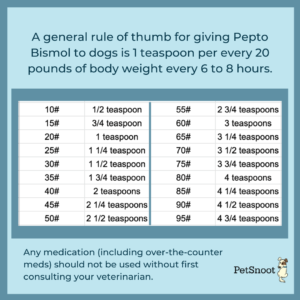
A general rule of thumb for giving Pepto Bismol to dogs is 1 teaspoon per every 20 pounds of body weight every 6 to 8 hours.  Please know, any medication (including over-the-counter medications) should not be used without first consulting your veterinarian.  If your dog becomes lethargic or diarrhea persists for more than 24 hours call your veterinarian.

Can I give Pepto to my cat for diarrhea?

Do NOT use Pepto in cats as they are sensitive to aspirin.   Did you know 30mL of Pepto contains approximately 325 mg of aspirin?  If your cat has diarrhea, call your veterinarian.

In many cases of diarrhea in dogs, we should allow the body to do what it does best, hence the phrase “let it run its course.”  As pet owners, we want what’s best for our pets and want to be sure we offer the right help.  It can be challenging for pet owners to feel confident they are doing the right thing when their pet is ill.  When in doubt, it’s always best to call your veterinarian.  

Overdoses can be dangerous due to the salicylate component of Pepto Bismol. If you suspect an overdose, seek emergency veterinary attention or call the ASPCA poison control hotline on (888) 426-4435.


PetSnoot receives zero compensation for these reviews and the opinions provided are solely based on personal experiences with these products.

Super Chewer Bark Box:

Recently while scrolling through my Facebook feed, I came across an ad for a Bark Box subscription. At the time, my dog was recovering from a tumor removal surgery, which made it easy to cave and sign her up for a 6-month subscription.

She’s a 45# shepherd mix, nine years old at the time, loves to play fetch with her toys, and never turns down a treat.  I was excited to surprise her with an automatic delivery of toys and treats every month.

There are 2 types of boxes to choose from: a Bark Box with soft fleece toys or a Super Chewer Bark Box with super-tough toys.  I selected the Super Chewer box since my dog is not a fan of toys with floof.  Each monthly box has a themed collection including 2 tough toys, 2 full-size bags of treats, and 2 meaty chews.  

Why I love this service:

Nothing is set in stone.  If you want fewer treats or more toys, the options are endless to customize your box to suit your pet’s needs.   The treats are customizable for allergy or diet preferences with high-quality ingredients and the meaty chews are always all-natural.  

One of the best parts is the creative themes for each box.  The toys and treats always reflect whatever the theme is for each month, and the packaging is on point.  This makes the monthly box reveal just as much fun for the pet owner as for the pet.

Why I love this company:

The customer service is top-notch!  Contacting customer service is easy, and their website has a plethora of Q and A’s, which makes finding answers quick and easy.  I emailed customer service to change the types of toys included in my dog’s box and was thrilled with the response.  I even copy and pasted it at the bottom of this review to show the level of service to be expected.

In addition to impeccable service, if a toy isn’t tough enough for your super chewer, they will replace it 100% free of charge.  For a subscription as low as $30 a box, your dog gets more than $45 worth of toys and treats with free delivery.

What would I change about this service:

There isn’t much I would change about this service.  I have been particularly impressed with the customer service, as well as the flexibility to build the perfect box for my dog.  If I had one complaint, it’s that their subscriptions are set to auto-renew.   For that reason, I give the service a rating of 4.5 out of 5 stars.

Click here to check out their website.

See my email reply for customizing Lacey’s subscription below.

Hi there, Kasey and Lacey!

This is Kristen and my pup, Odin from the Super Chewer Team at BARK, here to lend a paw! Thank you so much for barking in! I’d be happy to help with this!

I’m so sorry to hear not all of Lacey’s boxes have been a hit out of the dog park for her! I’d be happy to explore some alternative options with you! 

It sounds like Solid Nylon are the toys she doesn’t really play with. What I can do is tailor her Super Chewer box for Never Solid Nylon, which will increase the number of Rubber toys she receives. 

The other option we do offer as well is including a More Durable Plush toy in place of one Super Chewer toy. This way she gets more of a variety and overall softer toys in general! 

Let me know if either (or both) of these options are worth a try! You can make as many needed changes as often as you like before the 30th of each month! 🙂 

Looking forward to building a better box for your special pup! <3 

Happy chewing,

Kristen and Odin

BARK Happy Super Chewer Team

“Making playtime last longer”

A sniff walk allows your dog to sniff whatever he or she wants during a walk.  Dogs LOVE to sniff.  In fact, a dog’s sense of smell is 1000 times greater than a human’s.  Dogs have around 300 million olfactory receptors, whereas humans only have around 6 million.

Many of us spend time scrolling through social media, reading posts and comments, and sometimes sharing our opinions or stories.   A daily sniff walk can serve as your dog’s version of social media.  

Rather than hurrying along and focusing on the destination, try slowing things down a bit and letting your dog’s nose lead the way for a bit.  At times this can be challenging, but if you really pay close attention to what your dog is doing, you will see the joy this “sniffari” will bring them.  

Sometimes it helps to let your dog lead the way during the first 10 minutes or so, then use command words (ie: heel or leave it) to direct them to an exercise pace without the stop and sniff.  Having a small size treat on hand to reward good behavior can make this transition during your walk much easier.  Positive rewards and consistency with commands and routine can help teach your dog the difference between exercise, sniff walks, late-night potty walks, or hikes with other canine friends.

While improving enrichment for your pet should be a goal, it is important to set boundaries and remember leash manners.  Not all dogs are suited for these types of walks.  It is important that they’ve learned how to properly walk on a leash first. 

You’ve heard the saying “stop and smell the roses.”  Perhaps we can all benefit from a daily sniff walk to decompress and take in nature.   

Dogs “see” the world through scent.  This is how they interact with their environment.  Try giving them an opportunity to “scroll” through their social media on your next walk and comment below to let us know how it went.

As of October 2020, the FDA is alerting pet owners about certain pet food products manufactured by Sunshine Mills.  There are several brand names that may contain unsafe levels of aflatoxin. 

What is aflatoxin?

Aflatoxin is produced by the mold Aspergillus flavus, a mold that can grow on corn and other grains used as ingredients in pet foods.

What are the symptoms of aflatoxin poisoning?

  • Sluggishness
  • Loss of appetite
  • Vomiting
  • Diarrhea
  • Jaundice (yellowish tint to eyes or gums)

What should I do if my pet’s food is found on the list of products involved?

The FDA is advising pet owners to stop feeding their pets the recalled products.  Contact the company listed on the package for further instructions or dispose of them in a way that children, pets, and wildlife cannot access them.  Please note, the toxin can be present even with no evidence of visible mold.  It is also recommended to sanitize food bowls, storage containers, and scoops using bleach and rinsing well with warm water.

If your pet has been impacted by the list of symptoms above, contact your veterinarian immediately.

 Click here for a complete list of products involved.


Some cats bring a whole new meaning to “Door Dash”.   You may be surprised to learn that most cats, especially indoor cats, don’t typically go far from home. Dogs often have the energy to travel long distances; however, cats typically don’t venture as far.  Many lay low for days or weeks, hiding and waiting.  

While there is no guarantee that you’ll get your cat back home safe and sound, it is vital that you are equipped with the information that can help you succeed in getting kitty back.  

What should I do when my cat has escaped?

First, do a very thorough home search.  You’d be surprised how many cats thought to have escaped outside turn up hidden in strange nooks and crannies in their own home.  After carefully searching your home, try the following tips:

  • Leave your garage door cracked.  Many cats like to sneak back home late at night. 
  • Appeal to their sense of smell.  Put items with familiar scents outside.  These could be articles of worn clothing, a pillowcase that has been slept on, a favorite bed or blanket.
  • Lure them with food that has a strong aroma.  Try foods such as tuna or sardines, as opposed to their normal food.  Place it close to your front door and reheat it every now and then to keep the smell going strong. 
  • Search at night, when the world is asleep.  Cats are nocturnal and like to be active during the night and early morning.
  • Get the word out.  Talk to your neighbors and make flyers with your cat’s picture (be sure to keep a current photograph handy).  Use fluorescent paper and keep the words large and brief.  Hang the flyers at eye level throughout your neighborhood, at local veterinary offices, and pet stores.
  • Call the local shelter, give them a description of your cat and your phone number.
  • Check for lost and found pet groups on social media.  Many of these groups have been very successful at locating lost pets and returning them to their owner.

What if I see my cat run out the door?

First of all, stay calm and keep an even tone!  Cats are drawn to the comfort of your normal voice, NOT frantically screaming their name.  Don’t scream and yell, or run after them.  If your cat stops to look at you, don’t look them in the eye.  It’s best to kneel down and stretch out your arm calling them in a calm voice.

Is there anything I can do to prevent this from happening?

You can encourage your cat to stay away from the front door with continual training.  If you see your cat lying near or approaching the front door, make a loud noise, or clap your hands to shoo them away.  

During training, or if your cat is just plain stubborn, put a sign by the front door to warn visitors that your cat likes to dash out and to please close the door quickly behind them.

Keep a tear away collar with an ID tag on your cat at all times.  Also, have your cat microchipped in case the collar does come off.  The American Veterinary Medical Association did a study on 7,700 stray dogs and cats that ended up in a shelter.  Cats without a microchip were returned to their owner only 1.8% of the time, while cats WITH a microchip were returned to their owner 38.5% of the time.  Microchipping represents a significant improvement in the chances that your pet will be returned home! 

Most indoor cats are not equipped to handle being outside of their comfort zone and oftentimes come home immediately.  For those that don’t return right away, they are likely to stay within a 5 house radius for the first few days or weeks.  Don’t give up!  

For more tips visit https://missionreunite.org/

Can you think of any additional tips to add?  Please share your story.  We’d love to hear from you!

Despite the risks involved with the current pandemic, veterinary clinics around the country are working harder than ever to continue offering compassionate care to pets in need.  However, it isn’t business as usual.  Each clinic has its own protocol in order to protect the health, safety, and well-being of their staff members, clients, and patients.  

Many practices are seeing patients inside, while pet owners wait in their vehicle, and follow up via phone to communicate about the visit.  My dog is due for her vaccines and has a couple of issues, due to old age, that I’d like to discuss with her veterinarian.  Because I’m no longer working in a private practice setting, I will need to wait outside during my dog’s exam.  I have to admit, at her age I prefer the opportunity to be there for her appointment, but totally understand that current circumstances have made this impossible.  

After talking with a few pet owners that have similar concerns, and hearing about the new and different stress that this also brings to my past veterinary colleagues, I decided to try and help.

How can I make this visit less stressful for me and my pet?

As pet owners, it is our responsibility to find out what protocols are in place at the veterinary clinic we plan to attend.  Many of them have updated information on their websites, or you can call and ask while you schedule your appointment.  Please keep in mind, if you don’t like the policies they have in place, this is not entirely under their control and they have a responsibility to protect themselves, their staff, and the public.

When you are scheduling your appointment, be very clear about the reason for your visit.  Don’t schedule an appointment for a re-check to get medication refilled, and show up asking for a full exam with a long list of issues that need to be addressed.  Being clear about the reasons your pet needs an exam will help your clinic to block the appropriate amount of time for your visit, ensuring that your pet gets the attention that he/she needs and that the clinic can keep appointments running on time.  

What should I do to prepare for the visit?

I recommend filling out the forms linked below prior to your visit and giving it to the staff member that will be with your pet during the exam.  

*PetSnoot Tip:  Upon completion, take a picture of the form on your phone so you can refer to it during a conversation with the doctor.

Canine Patient Visit Sheet

Feline Patient Visit Sheet

What should I expect in a curbside veterinary visit?

While different clinics are operating under different rules, many will ask you to call upon arrival and wait inside your vehicle for the hospital staff to come out and retrieve your pet.  Once inside, your veterinarian will examine your pet and will call you to discuss the exam.  When they have finished, a hospital staff member will come out to your vehicle and return your pet.  Expect to pay for your visit over the phone with a credit card.

Below are some tips to make this visit run smoothly for you, your pet, and your veterinarian:

  • Be clear on your vehicle make, model, and color upon checking in
  • Cats and small dogs should be inside a carrier
  • Larger dogs should be on a leash (don’t be offended if the veterinary staff puts another “lead leash” on before removing the dog from your vehicle, as this is the recommended practice to prevent them from slipping out of, or breaking collars)
  • Bring your completed patient visit sheet and hand it to the veterinary staff member when they retrieve your pet
  • Be open to ordering your medications and pet food via your veterinarian’s online pharmacy to have them delivered to your home
  • Please be understanding and patient during your visit

Veterinary visits are stressful enough for pets and pet owners.  Adaptations made due to COVID-19 have added even more stress.  It is our responsibility as pet owners to continue caring for our pets throughout the pandemic.  Arming ourselves with knowledge and adapting to these changes will make the process of veterinary visits much easier.  

Have you taken your pet to the vet during the pandemic?  If so, we’d love to hear more about your visit.

Meet my friend Sugar.  This 12-year-old labrador retriever has a very unique adoption story.  Sugar worked as a pheasant hunting dog at Thuderstik Lodge in Chamberlain, South Dakota for most of her life.  At the age of 9, she was officially put into retirement and needed a good home to live out the remainder of her senior years.  There aren’t many people willing to adopt an older dog, let alone a retired hunting dog that lived most of her life in a kennel setting.

PetSnoot’s interview with Sugar:

PetSnoot:  How did you end up with your new family?

Sugar:   When my adoptive mom’s dog, Cartwright, died she was so heartbroken it took her a couple of years to consider adopting again.  My adoptive dad was anxious to get a dog, and after some convincing, they finally decided it was time.  

My new parents are outdoor enthusiasts and love to go hunting and fishing.  They both agreed on adopting an adult dog that could participate in their outdoor activities.  Upon searching for rescued or retired hunting dogs, they came across Thunderstik lodge.  

After perusing the page with dogs currently available for adoption, they decided (despite the long drive from Ohio to South Dakota) to come and meet me to see if I’d be a good fit for their home.

PetSnoot:  What was it like working and living at the lodge?

Sugar: I went through extensive training with the guides before they let me hunt with guests.  Once I completed the training, they let me go hunting a lot!  The humans call it working, but I think it is a lot of fun.  There is nothing better than being outdoors, flushing out pheasants for the hunters, and getting to be around different people.  

They took great care of me at the lodge.  Everyone was really nice and I had a huge kennel to rest every night.  There were about 25 other dogs that were either actively hunting with guests, going through the training program, or waiting for their forever home.  

After I reached middle age, they decided the long days were too much for me and I officially retired.  When that happens, they put my information on their website for potential adopters to learn all about me.  That’s how my new family found me!

PetSnoot:  Tell us about your new family,  what was it like to meet them?

Sugar: My adoptive parents drove all the way from Ohio.  They said it took about 15 hours to drive here.  Before they drove here the lodge told them I could still hunt, but not full time, and I would make a great house pet with some training.  I didn’t know exactly what they meant by housetraining, but they said I sounded like the perfect fit for them so they made the long drive to meet me.

We got to spend the night together at the lodge. I was really happy when they decided they would take me home with them!  We loaded up the car and there was a really soft bed for me to lay on during our drive.  They laughed when I stood up and peed all over my bed while we were driving.  I don’t think I was supposed to do that, but they were very nice about it and said they would teach me about the housetraining.

PetSnoot: What was your new home like?

Sugar: After our long drive to Ohio, we finally made it home.  The house was much bigger than my kennel at the lodge.  There were different rooms and a fluffy dog bed for me to sleep on.  

My new parents spent a lot of time taking me to the back yard and I finally figured out about the housetraining.  It only took me a few days to catch on!  There is a sidewalk and a street with cars that make noises I’m not used to.  We took a lot of walks on the sidewalk, and I really enjoyed my new surroundings.  They called me an alpha dog because I like to bark at other dogs when they pass by.  After they introduced me to a few dogs in my yard, I don’t get as worked up when I pass other dogs on the street.  

They take me hunting every now and then, and we also go fishing in their boat.  I love my new home and my new parents seem to really enjoy having me there.  I’m getting older and like to sleep most of the time, but they don’t seem to mind.

Sugar is 12 years old now and still living her best life as a retired hunting dog in Ohio.  Her parents say there is much joy in adopting an older dog.  Even though they know their time with Sugar is limited due to her old age, they love having the opportunity to give her the best quality in what is left of her life.  

If you are considering adopting a dog, please know there are a lot of older dogs that need a loving home to finish out their senior years.  Hopefully, Sugar’s story will inspire other pet parents to consider gifting an older dog with a wonderful retirement home.

Do you have a unique adoption story to share?  We’d love to hear from you!


PetSnoot receives zero compensation for these reviews and the opinions provided are solely based on personal experiences with these products.

Coolaru Elevated Pet Bed:

While searching for a new bed for our dog, my husband and I agreed she needs something big enough to lay down comfortably and extra room to stretch out.   Our dog is what I consider a sprawler and despite her petite 40# frame, she likes to take up as much space as possible.

She was only 4 years old at the time of our search, and we were hoping to find something sturdy enough to last for many years and comfortable enough for her as she aged.  We also noticed how much she enjoyed laying on our back porch in the sun and wondered if we could find a bed that would be easy to clean and portable enough to take in and out.

After some searching, we came across the Coolaru Elevated Pet Bed.  This bed met all of the criteria we were looking for and more.  We purchased this bed in 2014 and it is still working out wonderfully for our dog.

Why I love this product:

The elevated design keeps her cool while she is lying in the sun, as the HDPE fabric keeps her fur cool by increasing airflow.  The off the ground design also reduces stress on her joints, which is a huge plus as she enters her senior years.  

One of my favorite things is how easy it is to clean by simply hosing off with water, and it never smells bad.  They are available in four solid colors, three sizes, and assembly was easy.  The frame is made of powder-coated steel and is lightweight, which is convenient when I bring the bed in and out.

Why I love this company:

They offer a 1-year warranty on the fabric for UV degradation and offer replacement parts, so you can replace parts as needed instead of buying the entire bed again.  I also like how they paid attention to detail with the curved frame, making the corners of the bed more comfortable.  You can purchase directly from them or visit their website to find a variety of retailers near you.   We ordered a medium size, which is listed on their website at $37.75.

What would I change about this product:

There isn’t much I would change about this product as the longevity of our dogs’ bed speaks for itself, especially with multiple hours of daily use.  I do wish they had more color and pattern choices, but when we bring ours inside we typically throw a blanket over it that matches our decor.  That way, I can simply throw the blanket in the wash as needed or leave the blanket off altogether.

Overall I would give the Coolaru Elevated Pet Bed 5 stars.  It has held up incredibly well and the ease of keeping it clean is priceless in my opinion.   For less than $40 this bed has exceeded my expectations.

PetSnoot receives zero compensation for these reviews and the opinions provided are solely based on personal experiences with these products.

Deshedding tool from SleekEZ:

While some pets shed more than others, the majority of our furry friends require some type of grooming.  Managing the amount of pet hair in my home is a full-time job.  My dog is a mixed breed with short hair and a thick undercoat.  She needs to be brushed regularly to remove excess hair and distribute natural oils in her fur and skin, which keeps her coat healthy.

Unfortunately, she hates being brushed.  Over the years, I’ve tried multiple types of combs, brushes, de-shedding tools, and blades on her coat and she squirms and fights me every step of the way.  It wasn’t easy to brush her until I tried the SleekEZ grooming tool!

This is the first tool for which she will not only sit still and let me brush her, but she actually enjoys it.  And the best part is, this grooming tool works really well.

Why I love this product:

The tiny teeth are configured in a unique tooth and wave pattern, which grabs the tips of the hair to extract without painful tugging.  When I first saw these tiny teeth, I was skeptical that it would be able to handle her thick undercoat.  Not only does it extract her undercoat, but the hair comes off in rows that fall to the ground without having to pull them off of the brush, making cleanup simple!

Why I love this company:

Their products are made in the USA, and satisfaction guaranteed.  They have multiple sizes available for dogs, cats, and horses, with a lifetime warranty against defects and workmanship and reasonable prices.  For example, I ordered a medium brush for my dog at $17.95.

What would I change about this product:

My only thought on this was to make it waterproof and more ergonomic for long term use.  When I looked on their website I was pleased to see they already thought of this.  They now have a new PRO SleekEZ designed for professional groomers, but available for pet owners as well.  It is designed to sustain wet conditions, with a 5” ergonomic handle.  

Overall I would give the SleekEZ 5 stars.  It definitely took the stress out of brushing my dog and works very well to remove excess fur and her undercoat.  For less than $20, this brush is well constructed and gets the job done.

Click here to find out more about why our pets shed.  To learn more about the SleekEZ or to purchase a brush for your pet visit their website at https://www.sleekez.com/

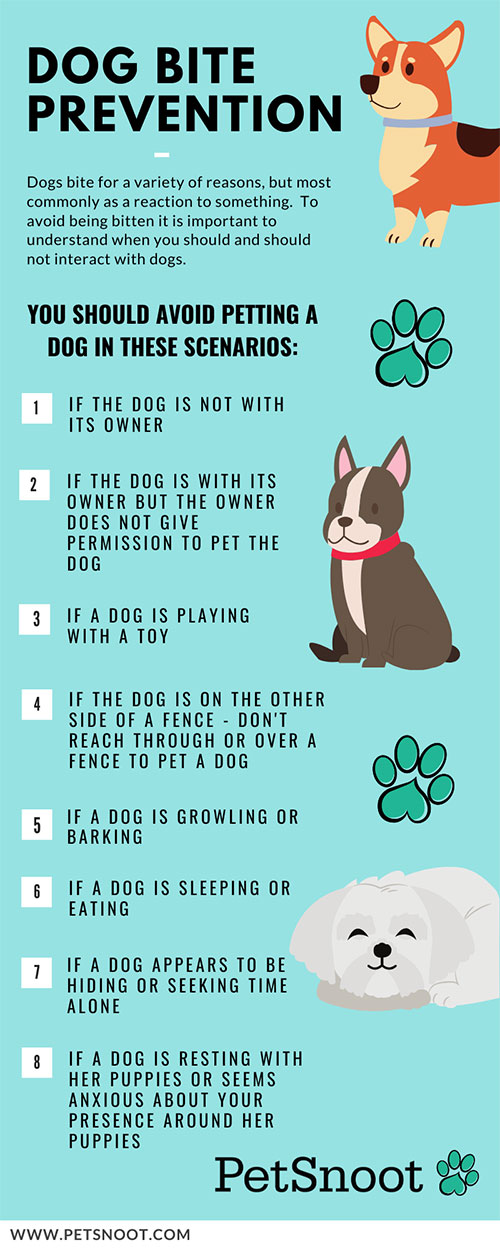
In order to prevent a dog bite, it is important to learn how to interact safely with dogs and understand how and when to approach them.  Also, It is especially important to educate children about this, as they are the most common victims of dog bites.  

When a dog bites someone, it is most commonly a reaction to something.  Knowing what dogs commonly react to and why is key to preventing a dog bite.  The Dog Bite Prevention graphic lists scenarios in which you should avoid petting or approaching a dog.

Keep in mind, even “good” dogs will bite if provoked.  Their breed, size, or age does not determine whether they will bite or not.   The best way to prevent a bite is to avoid risky situations and educate yourself and your children about when and if you should approach a dog.

An update on COVID-19 and how it affects our pets.

Since the last update from April 10, two house cats and one dog have tested positive for COVID-19.  The cats that tested positive are living in two separate areas of New York.  Each cat showed mild signs of respiratory illness and is expected to make a full recovery.

The dog that tested positive, living in North Carolina, had mild signs of respiratory illness.  There are two other pets (one dog and one cat) living in the same household that both tested negative, with two of the three humans testing positive.

What does this mean for pet owners?  

There is no evidence that animals play a significant role in spreading the virus; however, it is recommended by the CDC that you don’t let them interact with people or other animals outside the home.  It is also recommended that sick family members isolate themselves from pets, as the risk is to the animal, not from the animal.

What precautions should be taken?

Due to the evolving situation, it is recommended to follow the precautions below.

 For pet owners who test positive for COVID-19:

  • Restrict contact with pets and other animals while you are sick with COVID-19, just as you would with other people.
  • When possible, have someone else take care of feeding and otherwise caring for your pet.
  • If you have a service animal or you must care for your pet yourself, wear a cloth facemask; don’t share food, kiss or hug them; and wash your hands before and after any contact with them.

Pet owners who are not ill with COVID-19 can interact with their pets as normal and should continue to practice good hygiene before and after those interactions:

  • Wash hands before and after interacting with your pet, including when handling food, supplies, and waste.
  • Ensure your pet is kept clean.
  • Regularly wash your pet’s food and water bowls, bedding material, and toys.

It is important to remember that what is known about COVID-19 transmission right now is that most of it is happening human to human.   The precautions above are out of an abundance of caution, and there is no need to surrender your cat or dog. 

What if my pet needs to see a veterinarian?

Currently, veterinarians are following guidelines from the AVMA that include limiting in-patient appointments to emergency or critical care.  Many veterinarians are seeing patients by allowing one client in the office at a time.  Others are sending an employee wearing personal protective equipment out to the car to pick up the pet, while the doctor calls the owner to discuss diagnosis and treatment.

Many veterinary clinics are putting preventative care appointments, such as vaccines, spays, and neuters, on hold until further notice.   If you need to take your pet to the veterinarian, I recommend you check their website or call into the clinic to determine what procedures they currently have in place.   This is also a great time to support small businesses, including your veterinary clinic.  If you need pet food, flea/tick prevention, heartworm prevention, or other items from your veterinarian, please call them to see if you can place an order for curbside pick up. 

This is a tough time for us all.  Please stay safe, and stay tuned for more information and updates from PetSnoot.


An update on Covid-19 and how it affects our pets.

Recently, you may have seen a news article stating a tiger at the Bronx Zoo tested positive for Covid-19.  Public health officials believe this is a result of close interaction with an asymptomatic zookeeper. A total of seven tigers and lions have shown symptoms of respiratory illness, while only one was tested due to the difficulty involved in collecting a sample.  As of April 6, all of the affected cats are doing well and expected to make a full recovery. Currently, no other animals at this zoo are showing signs of respiratory illness.

What does this mean for our pets?

According to the CDC, USDA, and AVMA, there is no evidence that pets can transmit Covid-19 to people.  They have only seen sporadic cases of pets with positive test results, but most of them did not show any clinical signs.

Due to the evolving situation, it is recommended to follow the precautions below.

 For pet owners who test positive for COVID-19:

  • Restrict contact with pets and other animals while you are sick with COVID-19, just as you would with other people.
  • When possible, have someone else take care of feeding and otherwise caring for your pet.
  • If you have a service animal or you must care for your pet yourself, wear a cloth facemask; don’t share food, kiss or hug them; and wash your hands before and after any contact with them.

Pet owners who are not ill with COVID-19 can interact with their pets as normal and should continue to practice good hygiene before and after those interactions:

  • Wash hands before and after interacting with your pet, including when handling food, supplies, and waste.
  • Ensure your pet is kept clean.
  • Regularly wash your pet’s food and water bowls, bedding material, and toys.

It is important to remember that what is known about Covid-19 transmission right now is that most of it is happening human to human.   The precautions above are out of an abundance of caution, and there is no need to surrender your cat or dog. 

What if my pet needs to see a veterinarian?

Currently, veterinarians are following guidelines from the AVMA that include limiting in-patient appointments to emergency or critical care.  Many veterinarians are seeing patients by allowing one client in the office at a time. Others are sending an employee wearing personal protective equipment out to the car to pick up the pet, while the doctor calls the owner to discuss diagnosis and treatment.

Many veterinary clinics are putting preventative care appointments, such as vaccines, spays, and neuters, on hold until further notice.   If you need to take your pet to the veterinarian, I recommend you check their website or call into the clinic to determine what procedures they currently have in place.   This is also a great time to support small businesses, including your veterinary clinic. If you need pet food, flea/tick prevention, heartworm prevention, or other items from your veterinarian, please call them to see if you can place an order for curbside pick up. 

This is a tough time for us all.  Please stay safe, and stay tuned for more information and updates from PetSnoot.

Did you know that 50% of cats aged 5 – 11 years old weigh in higher than their ideal weight?  If you’re reading this, I’m guessing you are either concerned your cat may already be overweight or you’re curious why you should even care.  

Let’s face it, chubby cats are cute!  It’s no wonder, some of the most popular cartoon cat characters and cat memes are large and in charge.  So why should you be concerned about your cat being on the plump side?  

Extra weight on your cat could attribute to serious health concerns, and sometimes a shorter life span.

What are the health concerns associated with extra weight?

An increase in weight can hinder your cat’s normal propensity for physical activity, which can negatively impact their quality of life.  A few serious health issues associated with obesity are listed below:

  • Heart disease
  • Painful arthritis
  • Diabetes
  • Bladder cancer
  • Difficulty breathing
  • Hip dysplasia
  • Depression

When is a cat considered obese?

Obesity is an accumulation of excess body fat.  Identifying obesity in cats is best determined by using a body condition score.  This scale helps determine what condition is ideal for each individual pet. Relying on weight alone is inaccurate, as this can vary widely among different breeds.

Your veterinarian will need to perform a rib check (run both hands, across ribcage on either side), an overhead check (look down on the cat from above), and a profile check (view from the side).  Typically a scale similar to the one pictured below will be used to determine your cat’s body condition score.

Click here for more details.

What are some signs my cat may be overweight?

The signs listed below are a good indicator that you should schedule an appointment with your veterinarian to determine your cat’s body condition score, and potentially have additional tests to determine if there is a serious health concern that needs to be addressed.

  • Ribs cannot easily be felt when running your hand along your cat’s side
  • Loss of an obvious waist
  • Collar needs loosening
  • Difficulty in walking
  • Slow movement
  • Shortness of breath
  • Bad temper

How can I help my cat lose weight?

Your veterinarian will likely recommend a nutritional diet with a lower calorie density.  Gradual weight loss is the goal. Simply reducing the amount of your cat’s current food can actually cause serious health issues.  Especially if you reduce it too much, too fast!  

The following list gives some additional ways you can help your cat lose weight:

  • Encourage your cat to follow you up and downstairs and from room to room
  • Hide food and make them hunt for it
  • Use toys to encourage play (click here for an example of an interactive cat toy)
  • No table scraps or people food
  • Encourage 3 to 4 regular meal times instead of free-feeding

The easiest way to deal with obesity is prevention.  Beyond helping your cat to lose weight, the ideas listed above can be great habits to use in preventing obesity.

If you are concerned your cat is obese, be sure to schedule an appointment with your veterinarian to determine what your cat’s ideal weight should be, rule out any serious health issues, and develop a safe and healthy diet plan to get your cat back on track.


PetSnoot receives zero compensation for these reviews and the opinions provided are solely based on personal experiences with these products.

Cats have multiple scent glands located throughout their body.  These scent glands produce pheromones that are a type of chemical communication they use to interact with the world around them.  Feline facial pheromone spread happy messages that help cats feel safe and secure.

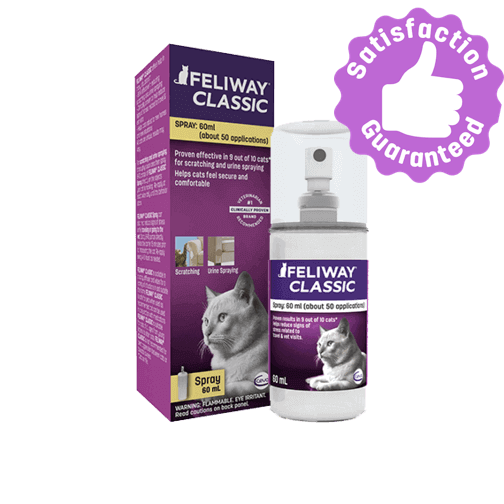
As you know, cats aren’t typically a fan of getting into the cat carrier, let alone taking a trip to the veterinary clinic.  Feliway Classic Spray utilizes the feline facial pheromones to provide a calming effect during these events and others that would otherwise be stressful for your cat.

I’ve used and recommended this spray during my career as a veterinary technician for many years.

Why I love this product:

I spray Feliway into a cat kennel about 10 minutes prior to putting a cat inside to help them feel more secure during their veterinary stay.   I’ve even sprayed it into my scrub top at work in order to help calm feline patients as I’m working with them.  Overall I experienced good results with this product alleviating some of the stress these patients endure.

I also recommend spraying this product into the cat carrier before cat owners attempt to bring them into the veterinary practice.  Many of these owners noticed a significant decrease in whining and meowing during the car ride, as well as less difficulty getting their cat into the carrier.

Why I recommend this product:

Pheromones are safe, and they don’t enter the bloodstream.  Feliway spray does not have an effect on people or other animals.  Also, there is no risk of exposing your cat to too many pheromones.  This product can also be used around the house to prevent scratching and urine spraying.

Feliway spray is available on Amazon here and costs approximately $13.20 for a 60mL bottle (about 60 applications).

Getting a cat into a carrier can be a difficult task!  It may seem easier to avoid dealing with a cat carrier altogether, but we can’t eliminate the need to take our cats to the veterinary clinic at least once a year.  When used correctly, this product can be very helpful in calming cats experiencing stressful situations. Click here to learn more about the feline facial pheromones and how cats use them to communicate.

Understanding which vaccines your dog needs is an important part of being an educated pet owner.  While it’s understandable that you don’t know everything there is to know about dog vaccinations and the diseases they protect against, understanding the basics outlined below will help to make your veterinary visit less stressful.  

It may surprise you to learn that not all dogs get the same vaccines.  Your veterinarian will determine which vaccines are necessary to keep your dog healthy based on your dog’s environment and lifestyle.

What are the diseases my dog may need to be vaccinated against?

There are two categories of vaccines, core, and non-core.    

Core vaccines are recommended for all dogs.  At this time the core vaccines are:

  • Canine Distemper Virus (CDV)
  • Canine Adenovirus (CAV – Hepatitis)
  • Canine Parvovirus (CPV)

**these first 3 core vaccines listed are typically combined into one booster shot (DHP-P)

  • Rabies Virus – while rabies is sometimes considered a non-core vaccine, it is required by law in many areas

Non-core vaccines are administered based on risk assessment according to your dog’s environment and lifestyle.  At this time the non-core vaccines are:

  • Bordetella Bronchiseptica (kennel cough)
  • Leptospirosis
  • Corona Virus
  • Canine Influenza (H3N8)
  • Lyme Disease (Borrelia burgdorferi)
  • Crotalus atrox (the western diamondback rattlesnake)

How does my veterinarian decide which vaccines my dog will need?

There are many factors that veterinarians consider when deciding which vaccines your dog needs.  

Some of these factors include:

  • Age
  • How many pets live in the household
  • Exposure to other animals
  • Introduction of new pets into the household
  • Stress associated with the change of social demographics (this can suppress the immune system, making them more susceptible to infection and disease)
  • Making trips to a grooming facility, dog park, or pet store
  • Attending obedience classes
  • Possibility of staying in boarding facilities or traveling in the future
  • Location (geographic distribution of infectious agents may result in different risks of exposure for dogs living in different areas)
  • Previous vaccination history

How often will my dog need to get each vaccine?

This varies with the type of vaccine, your pet’s age, lifestyle, local laws, and other health factors.  

Core vaccines:

  • Puppies typically receive their core vaccines around 6 to 8 weeks of age, with a booster every 3 to 4 weeks until they are 16 to 20 weeks old.  
  • These core vaccines will need boostered again a year later.  
  • Depending on factors listed previously, your veterinarian will determine if these vaccines will then be given every 1, 2, or 3 years thereafter.

Rabies vaccine:

  • Local and/or state laws mandate how frequently your dog must be vaccinated for rabies.
  • The earliest a dog can receive its first rabies vaccination is 12 weeks.  
  • After your dog receives it’s first rabies vaccine, it must have a booster one year later.
  • Subsequent rabies boosters will be determined by the type of vaccine used and state or local laws.

Non-core vaccines:

  • Non-core vaccines are typically given once every year.  
  • Depending on your dog’s exposure risk and the possibility of not lasting a full year, this interval may be shorter than one year.  

The overall purpose of vaccination is to protect each dog against infectious agents to which they have a realistic risk of exposure, while vaccinating no more frequently than necessary.  Due to the large list of factors that play a part in determining which vaccines your dog needs and how frequently they need boostered, it is necessary to reassess with your veterinarian every year.  

Why do the cost and frequency of giving these vaccines vary?

High-quality vaccines have become more and more expensive for vaccine makers, as they are highly regulated and pharmaceutical companies must jump through hoops to produce new and updated vaccines.  The result? These costs are passed on to veterinary practices, making some vaccines more expensive than others.

For example, some drug companies have improved the formula enough for vaccines that used to commonly cause tumors at the injection site to a point where this is very rare.  In addition to improving the formula of vaccines, they are also able to create longer-acting protection for some diseases.  This can affect the price of vaccines, as well as the frequency of boosters needed.

Vaccines that don’t contain the most up to date formulations aren’t necessarily unsafe, but it could mean they aren’t able to trigger as strong of an immune response as newer, more expensive shots.

In order to avoid multiple injections, some vaccines are configured to protect against more than one disease in one injection.  Likewise, some diseases have multiple variations within a species of bacteria or viruses.  Formulating vaccines that contain all possible variations adds more expense.  

Fecal Testing:

Your veterinarian may ask you to bring in a stool or fecal sample at your dog’s annual exam to check for intestinal parasites or “worms.”  Some of the parasites they are testing for include roundworms, hookworms, whipworms, tapeworms, coccidia, and giardia.  Some of these parasites are also a risk for humans, with children being at high risk due to their play habits and affection for pets.

This test is not required but is recommended annually. There is no individual deworming medication that will treat every type of parasite at once; therefore, the fecal test will determine which medication your pet needs.

Monthly heartworm prevention contains medication that also treats for some of the common intestinal parasites in dogs and should prevent them from becoming a problem.  

If your dog is experiencing the following symptoms, a fecal test is highly recommended.

  • Weight loss accompanied by a marked increase or decrease in appetite
  • Distended abdomen, or ‘pot-bellied’ appearance
  • Lethargy
  • Vomiting
  • Diarrhea/chronic soft stools
  • Rubbing or dragging the hindquarters across the ground
  • Visible presence of segments of tapeworms in dogs attached to the skin and fur around the anus/hindquarters area; look like tiny grains of rice or small flat segments of a worm
  • Visible presence of roundworms in dogs in infected stool; looks like spaghetti

Keep in mind, worms don’t always shed their eggs in the stool. Therefore, a negative result doesn’t completely rule out the possibility that worms are present.  For this reason, your veterinarian may recommend treatment anyway, especially if your dog is having any of the symptoms listed above.

Heartworm testing:

Heartworm testing requires a small blood sample from your dog and is typically scheduled during yearly vaccination exams.  Many clinics run heartworm tests in-house, oftentimes obtaining results before you leave the office.  Some clinics send the heartworm tests to a diagnostic laboratory, also getting results fairly quickly.

The American Heartworm Society recommends annual heartworm testing for adult dogs, even when they are on prevention year-round to ensure the prevention program is working.  Each veterinary clinic will determine their heartworm protocol based on these guidelines, as well as geographic location and other factors on a case-by-case basis.

Things to consider when questioning whether a heartworm test is necessary for your pet:

  • If just one dose of a monthly medication is missed or given late, it can leave your dog unprotected.
  • Your dog may spit out or vomit a heartworm pill, or rub off a topical medication.

If you live in an area where heartworms are prevalent and do not have the income to spend on annual testing, it is highly recommended to spend what is necessary to prevent heartworm disease monthly throughout the entire year.  Prevention is simple and inexpensive compared to the treatment of heartworm disease.

What is a microchip?

Microchips provide a form of permanent identification for your pet. Unlike a collar with tags, a microchip cannot fall off or get lost.  The American Veterinary Medical Association (AVMA) did a study on more than 7,700 stray animals at animal shelters.  The results showed that dogs without a microchip were returned to their owners 21.9% of the time, whereas dogs WITH a microchip were returned to their owners 52.2% of the time. Microchipping represents a significant improvement in the chances that your pet will be returned home! 

These tiny implants, the size of a large grain of rice, are typically injected under the skin between the shoulder blades using a needle and syringe similar to their vaccinations.  The needle used for microchipping is slightly larger than needles used for vaccinations, and are no more painful than a typical injection.  A microchip can be inserted at a routine vaccination visit or while your pet is sedated for a procedure, such as spaying or neutering.

Veterinarians and animal shelters have a scanner that uses radio waves to detect the chip, which then transmits the unique alphanumeric code registered to your dog.  The key here is to make 100% sure you remember to register your dog with the pet recovery database.  It is also important to update your information in the event you have a change of address or phone number.

Because our pets are considered as part of our family, many pet owners are becoming more involved in the health care of their pets.  Understanding the importance of the different vaccinations, staying on a vaccine schedule, and communicating with your veterinarian to determine which vaccines are necessary will help keep your dog healthy.

Click here to download your free Canine Patient Visit Sheet to communicate your questions and concerns with your veterinarian.

Understanding which vaccines your cat needs is an important part of being an educated pet owner.  While it’s understandable that you don’t know everything there is to know about cat vaccinations and the diseases they protect against, understanding the basics outlined below will help to make your veterinary visit less stressful.  

It may surprise you to learn that not all cats get the same vaccines.  Your veterinarian will determine which vaccines are necessary to keep your cat healthy based on your cat’s environment and lifestyle.

If my cat is indoors only, why does it still need vaccinated?

Without exposure to other animals or humans, indoors only cats don’t get the regular boosting to their immune system that other cats do.  This puts them at a greater risk when exposed to the viruses we bring home on our clothes or shoes.

If your cat does not get these vaccinations, their immune system will be unable to fight these diseases and they will be at risk of serious illness or death.

What are the diseases my cat may need vaccinated against?

There are two categories of vaccines, core and non-core.    

Core vaccines are recommended for all cats.  At this time the core vaccines are:

  • Feline panleukopenia (FPL) – also called feline distemper
  • Feline Viral Rhinotracheitis (FVR)
  • Feline Calici Virus (FCV)

*these first 3 core vaccines listed are typically combined into one booster shot (FVRCP)

  • Rabieswhile rabies is sometimes considered a non-core vaccine, it is required by law in many areas

Non-core vaccines are administered based on risk assessment according to your cats environment and lifestyle.  At this time the non-core vaccines are:

  • Feline Leukemia (FELV)
  • Feline Immunodeficiency Virus (FIV) 
  • Feline Infectious Peritonitis (FIP)
  • Feline Chlamydiosis
  • Bordetella Bronchiseptica

How does my veterinarian decide which vaccines my cat will need?

There are many factors that veterinarians consider when deciding which vaccines each cat needs.  

Some of these factors include:

  • Age
  • How many cats live in the household
  • Exposure to other cats
  • Introduction of new cats into the household
  • Stress associated with the change of social demographics (this can suppress the immune system, making them more susceptible to infection and disease)
  • Possibility of staying in boarding facilities or traveling in the future
  • Location (geographic distribution of infectious agents may result in different risks of exposure for cats living in different areas)
  • Previous vaccination history

The overall purpose of vaccination is to protect each cat against infectious agents to which they have a realistic risk of exposure, while vaccinating no more frequently than necessary.

Due to the large list of factors that play a part in determining which vaccines your cat needs and how frequently they need boostered, it is necessary to reassess with your veterinarian every year.  

Why do the cost and frequency of giving these vaccines vary?

High quality vaccines have become more and more expensive for vaccine makers, as they are highly regulated and pharmaceutical companies must jump through hoops to produce new and updated vaccines.  The result? These costs are passed on to veterinary practices, making some vaccines more expensive than others.

For example, some drug companies have improved the formula enough for vaccines that used to commonly cause tumors at the injection site to a point where this is very rare.  In addition to improving the formula of vaccines, they are also able to create longer acting protection for some diseases. This can affect the price of vaccines, as well as the frequency of boosters needed.

Vaccines that don’t contain the most up to date formulations aren’t necessarily unsafe, but it could mean they aren’t able to trigger as strong of an immune response as newer, more expensive shots.

In order to avoid multiple injections, some vaccines are configured to protect against more than one disease in one injection.  Likewise, some diseases have multiple variations within a species of bacteria or virus. Formulating vaccines that contain all possible variations adds more expense.  

Fecal Testing:

Your veterinarian may ask you to bring in a stool or fecal sample at your cat’s annual exam to check for intestinal parasites or “worms.”  Some of the parasites they are testing for include roundworms, hookworms, tapeworms, coccidia, and giardia.  Some of these parasites are also a risk for humans, with children being at high risk due to their play habits and affection for pets.

Cats can get internal parasites from eating a flea while grooming, eating rodents or insects, or ingesting contaminated soil or water.  Indoor-only cats, while at lower risk, can still be exposed to parasites from pets that do spend time outdoors, or even from people bringing parasite eggs from outside.

This test is not required but is recommended annually.   There is no individual deworming medication that will treat every type of parasite at once; therefore, the fecal test will determine which medication your pet needs.

If your cat is experiencing the following symptoms, a fecal test is highly recommended.

  • Weight loss accompanied by a marked increase or decrease in appetite
  • Distended abdomen, or ‘pot-bellied’ appearance
  • Lethargy
  • Vomiting
  • Diarrhea/chronic soft stools
  • Rubbing or dragging the hindquarters across the ground
  • Visible presence of segments of tapeworms in cats attached to the skin and fur around the anus/hindquarters area;  looks like tiny grains of rice or small flat segments of a worm
  • Visible presence of roundworms in cats in infected stool; looks like spaghetti

Keep in mind, worms don’t always shed their eggs in the stool.  Therefore, a negative result doesn’t completely rule out the possibility that worms are present.  For this reason, your veterinarian may recommend treatment anyway, especially if your cat is having any of the symptoms listed above.

What is a microchip?

Microchips provide a form of permanent identification for your pet.  Unlike a collar with tags, a microchip cannot fall off or get lost.  The American Veterinary Medical Association (AVMA) did a study on more than 7,700 stray animals at animal shelters.  The results showed that cats without microchips were returned to their owners 1.8% of the time, while cats WITH a microchip were returned to their owner 38.5% of the time.   Microchipping represents a significant improvement in the chances that your pet will be returned home! 

These tiny implants, the size of a large grain of rice, are typically injected under the skin between the shoulder blades using a needle and syringe similar to their vaccinations.  The needle used for microchipping is slightly larger than needles used for vaccinations, and are no more painful than a typical injection.  A microchip can be inserted at a routine vaccination visit or while your pet is sedated for a procedure, such as spaying or neutering.

Veterinarians and animal shelters have a scanner that uses radio waves to detect the chip, which then transmits the unique alphanumeric code registered to your cat.  The key here is to make 100% sure you remember to register your cat with the pet recovery database.  It is also important to update your information in the event you have a change of address or phone number.

When do cats need a Feline Leukemia Test (FeLV test)?

For the majority of cats and kittens, it is highly recommended to test for Feline Leukemia prior to administering the vaccine.  Once a negative result has been established, your veterinarian will determine the schedule for these vaccinations depending on age and risk level.  Examples of high risk are living or going outdoors and catfights.  Also, if your cat is new to the family or you adopt another cat, testing is recommended before you introduce the new cat to other cats in the household.   

If your cat is not considered high risk, has had a negative test, and received the Feline Leukemia vaccine per their veterinarian’s recommended schedule, they typically don’t need another test unless they become ill or a high-risk situation should occur.

Because our pets are considered as part of our family, many pet owners are becoming more involved in the health care of their pets.  Understanding the importance of the different vaccinations, staying on a vaccine schedule, and communicating with your veterinarian to determine which vaccines are necessary will help keep your cat healthy. 

Click here to download your free Feline Patient Visit Sheet to communicate your questions and concerns with your veterinarian.




It always amazes me how some dogs will eat just about anything.   Rocks, poop, shoes, underwear, trash, children’s toys, just to name a few.  

Many dogs eat whatever they stumble upon, and some have turned counter surfing into an Olympic sport. Beyond just being annoying, this behavior can have serious health consequences for your pet, including death.

Unfortunately, some seemingly innocuous items that are perfectly safe for humans are toxic to dogs. The substance, xylitol, has become increasingly popular as a sugar substitute found in many household items.  

Xylitol is extremely toxic to dogs.

In what products can I find xylitol?

There are a number of products that contain xylitol.  Some of these items include:

  • Cough syrup
  • Sugar-free gum
  • Candy
  • Breath mints
  • Baked goods
  • Chewable or gummy vitamins
  • Mouthwash
  • Toothpaste
  • Pudding snacks
  • Diabetic snacks and foods
  • Nasal sprays
  • Baby wipes
  • Deodorant
  • Face gels
  • Hair products

What happens when dogs eat xylitol? 

When dogs consume something that contains xylitol, it is quickly absorbed into the bloodstream, resulting in a potent release of insulin from the pancreas.  This causes a rapid decrease in blood sugar, a condition known as hypoglycemia, and in severe cases liver failure. When this goes untreated it can be fatal.

How much xylitol does it take to make my dog sick?

Dosages of xylitol over 34 to 45mg/pound have been associated with hypoglycemia.  Some dogs ingesting xylitol at dosages over 227mg/pound can develop liver failure.  The higher the dose, the higher the risk of liver failure. It is important to identify if a toxic amount of xylitol has been ingested.  

For example, different brands of gum contain different amounts of xylitol.  The typical range of xylitol is 300mg to 1500mg/piece of gum; therefore, a 20-pound dog can experience toxicity after ingesting one piece of gum containing 1000mg.

What are the symptoms of xylitol poisoning?

Signs of xylitol toxicity can occur as soon as 15 minutes after consumption.  Some signs to look for include:

  • Weakness
  • Depression or lethargy
  • Lack of coordination or difficulty walking or standing
  • Vomiting
  • Trembling or tremoring
  • Seizures

What do I do if I think my dog is suffering from xylitol poisoning?

Call your veterinarian or Pet Poison Helpline (855-764-7661) immediately.  Do not induce vomiting unless specifically directed to do so by your veterinarian.  If your dog is already hypoglycemic, inducing vomiting can make it worse.

Now that you know what to look for, read those labels and be sure to keep products containing xylitol away from your dog.  If you have a lot of sugar-free foods in your home, be careful not to share these foods with your dog.

If you have cats in your home, you are probably wondering if they too can suffer from xylitol poisoning. While there are no reported cases of xylitol poisoning in cats, it is best to keep substances containing xylitol away from your feline friends as well.  Better to be safe than sorry!


Working in a veterinary practice is one of the hardest jobs I’ve ever had. There were physical and mental stresses to be dealt with on a daily basis. Believe it or not, getting bit, scratched, peed, or pooped on was the least of my worries.  

One of the hardest parts of working in a veterinary practice was the emotional toll it took on me every single day.  Worrying about a sick patient, dealing with euthanasia, and emergencies are just a few examples. For me, the worst part was hearing pet owners say things like “if you really cared about animals you would treat my pet for free.”

This may surprise you, but veterinarians and technicians don’t go into this profession to make money.  Most people are shocked when they find out just how little the average veterinarian makes in comparison to a physician in general practice.

Trust me, every veterinarian I’ve ever known would love to help their patients for free.  In reality, this just isn’t an option. A veterinary hospital is a business. As with all businesses, there are expenses involved.

A few of these expenses include:

  • Staff members
    • Technicians, Assistants, Receptionists, Kennel Attendants, Management, Associate Veterinarians, Janitorial Staff
  • Pharmaceuticals
  • Medical supplies
  • Equipment
  • Rent, building expenses

Are all of the tests and treatments suggested by your veterinarian really necessary?

Running tests help your veterinarian make an accurate diagnosis and determine what medications and treatments are best for each case.  

For example, if your pet has an ear infection they may want to run tests to determine:

  • which type of medication will work best
  • how long it should be treated
  • are there ear mites present
  • is the eardrum intact
  • is there an underlying problem such as allergies

Why is the medication so expensive?

The cost of medication is high for your veterinarian as well.  There is a markup on the cost, but many times this barely covers the expense of packaging and time spent dispensing meds. 

You may notice that online pharmacies have the same medication at a much cheaper rate.  Keep in mind these are large corporations that are capable of purchasing in bulk; therefore, giving them the ability to take advantage of a large discount.  

What is the best way to avoid costly visits?

If you’re reading this blog, then you probably feel the same as I, that pet ownership is a blessing.  But all owners and prospective pet owners need to be aware that there are expenses involved, not least of which are the costs of pet health care.

But as with humans, prevention is the key to lowering costs, as well as ensuring that your pet is as happy and healthy as it can be.  The old adage that an ounce of prevention is worth a pound of cure is absolutely applicable to our pets.

Here are a few ways you can prevent costly treatments.

  • Keep vaccinations current
  • Bring your pet in for a yearly exam
  • Give flea/tick and heartworm prevention monthly
  • Feed a healthy diet
  • Get your pet’s teeth cleaned regularly
  • Follow your veterinarian’s treatment plan and at-home care instructions

Prevention isn’t always cheap.  Paying for a yearly exam, vaccines, and a supply of flea/tick and heartworm prevention adds up quick.  For example, heartworm preventive alone can cost over $10 a pill.  

In my location, it is recommended to treat my dog with heartworm prevention monthly throughout the entire year.  This adds up to a lot of money, but it costs a lot less to prevent heartworms than it does to treat it.  

Should I share my financial concerns with my veterinarian?

Absolutely!  You must be your pet’s advocate.  Ask questions about the proposed treatment plan, and let your veterinary team know ahead of time about any financial concerns you might have.  You should feel comfortable expressing concerns, asking questions, and making decisions on how to proceed with a treatment plan that you are comfortable with.

It’s time to start seeing the value in veterinary visits.  We spend money on cushy beds, fancy bowls, toys, collars and matching leashes without batting an eye.  When it comes to keeping our pets healthy, we need to keep in mind the costs involved.  

Remember, your veterinary team chose veterinary medicine because they LOVE animals, and dedicate their lives to helping them.  It is important that you see the value in the services offered. Keep in mind, fees will vary with locale and clinic. Visit veterinary hospitals in your area and choose the clinic that provides the best care at a price you are comfortable with.  

Click here to visit our veterinary resources page to find clinics near you.

Veterinary visits can be stressful for so many reasons.  It wasn’t until I stopped working for a veterinary clinic and had to take my dog for a sick visit, that I realized how stressful this can be for pet owners as well as their pet. Having worked behind the scenes at a vet clinic for over 20 years, this was the first time that I truly understood what it feels like for pet owners to be on that side of the exam table.  

Can you relate to any of these concerns?

  • Will they be annoyed if I bring a list of questions?
  • What if I’m unsure about the treatment plan my vet proposed; will they judge me for asking to wait on a certain test or treatment?
  • Will I be able to afford the recommended treatment?
  • My pet gets really stressed out when I take them to the vet; I’d rather not go at all.

With all of these emotions and concerns, it’s no surprise that bringing your pet to the vet can be stressful.  So let’s shed some light on how we can get the most out of these visits and make them a positive experience for you and your pet.

Information to write down/bring with you:

  • Take a picture of your pets food bag & know how much you are serving your pet each day
  • Lumps and bumps can be easy to find at home and impossible to find when at the vet. I recommend marking these with a Sharpie or small dot of nail polish.
  • List of medications and supplements (including flea/tick/heartworm prevention)
  • Vaccination history (especially if going to a different veterinarian)
  • List any lifestyle notes regarding boarding, grooming, travel, obedience, etc
  • List any behavior questions or concerns
  • List changes in appetite, mobility, urination or bowel habits
  • List symptoms, when you first noticed them, and any changes since then

Tell your vet everything!

Regardless of the reason for your pet’s visit, it is vital that you share as much information as possible with your vet.   You know your pet best, and any unusual changes or behaviors are key to diagnosing what is wrong with your pet. The patient can’t speak for themselves, so be sure to give your vet all the information!

Sometimes pets do the unexpected, leaving pet owners in an embarrassing situation.  Trust me, your veterinarian has heard it all! If you are in one of these situations, don’t withhold the truth.  They aren’t interested in judging you, and can’t make the correct diagnosis or treatment without knowing all the details. 

It’s ok to ask questions and keep asking until you feel comfortable with the explanation.

Your veterinarian doesn’t want you to leave the appointment confused or unsure about the diagnosis or treatment plan.  Don’t be afraid to ask questions, and be sure to tell them if you don’t understand something so they can better explain it.  If you’re uncomfortable with any instructions for at-home care, be sure to let them know. Your veterinary team wants you to leave feeling confident and happy with your visit.

As a pet owner, veterinary visits are unavoidable.  Bringing a list of prepared questions and information to share with your veterinary team will make these visits less stressful for everyone. The most important thing to remember is, your veterinarian wants to keep your pet healthy and they rely on pet owners to be their pets voice.  

What is the hardest part about taking your pet to the veterinarian?  We’d love to hear from you!


One of my favorite things about guinea pigs are all the cute little noises to show their affection.  In addition to squeals, chirps and purrs, guinea pigs are also known to jump straight up and down in the air when they are happy, commonly referred to as “popcorning.”  These adorable little pocket-sized pets can be hard to resist.  

Unless you’ve already had the experience in owning one, there are many things to consider before adopting one into your pet family.   Don’t let the term “pocket pet” fool you into thinking these furry little pigs are low maintenance pets. Once you do some research, they could be the perfect addition to your family, but first there are a few things they want you to know.

We need a large cage and plenty of space for exercise

Many people are surprised to know that a single guinea pig requires a cage size of 7 ½ square feet, and two guinea pigs require a cage size of 10 ½ square feet.  They need a safe place that allows them to run, jump, explore, and potentially hide from environmental stressors. Also, be sure to keep their home away from drafty windows.  It is recommended to keep their environment around 70 °F.

We like soft clean bedding

Aspen, pine, recycled paper, or fleece bedding over absorbent material work well.  Never use cedar bedding as it is toxic for your guinea pig. It is also important to have a solid bottom in their cage to help in avoiding potential leg injuries.  

Their cage will need cleaned on a weekly basis.  Bedding should be changed out monthly, and food and water containers will need to be cleaned every day.

We love being pampered

One thing you may be surprised to learn is that guinea pigs need some grooming as well.  Short haired breeds need brushed once a week, and long haired breeds need brushed every day.  Their little nails need trimmed every 4 to 6 weeks.

Guinea pigs also need daily interaction!  It is vital to provide a safe place to give them time out of their cage every day to stretch those little legs and explore their environment.  This is an important time commitment to keep in mind before adopting a guinea pig.

Eating is our favorite

Guinea pigs LOVE fresh hay!  They should have unlimited access to a variety of quality grass hays.  They typically eat piles of hay twice the size of their body every day.

These little love bugs cannot make their own supply of vitamin C, so it must be supplied for them.  To ensure your guinea pig is getting the essential vitamins and minerals not found in hay, provide a daily high fiber fortified diet with stabilized vitamin C.

Fresh kale, romaine, red leaf lettuce, shredded carrots, and/or zucchini can be added every few days.  A fruity snack like papaya, banana, or mango can be added once a week. Always be sure to remove any food that isn’t eaten!

We are social butterflies

Not only do they love their time bonding with their family, they also love having a companion.  Are you willing to adopt two guinea pigs? This is something to consider, as guinea pigs do best with the companionship of another pig.  

Sometimes we don’t feel good, and may require a trip to the veterinarian

Keep an eye on your guinea pig and be sure to visit your veterinarian if you notice any of the following behavior or health issues.

  • Abnormal eating or drinking
  • Loose, soft, or lack of stool
  • Blood in the urine
  • Sneezing or trouble breathing 
  • Hunching in corner or lack of activity (lethargy)
  • Overgrown front teeth 
  • Observed difficulty with chewing 
  • Bald patches in the fur
  • Sores on the feet 

Guinea pigs can be a wonderful addition to any animal loving family that is willing to put in the time and effort to care for them.  If you are considering adding one or possibly two to your pet family, it is important to do your research and be prepared.   We’ve compiled more information that you can find here.  

Are you an experienced guinea pig owner with tips or stories to share?  We’d love to hear from you!


Does the thought of finding a flea on your pet terrify you?  Have you heard horror stories of pet owners finding fleas inside their home, sometimes in the dead of winter?  How can that be possible?  Don’t fleas die when it gets cold?

I’m going to show you how this IS possible, give you the information you need to understand the flea life cycle, and show you how to get rid of fleas if they’ve moved in to your home.

What is it about these pesky freeloaders that puts pet owners on edge?  Why is it so scary to think of having a flea problem in your home or on your pet?

  • Fleas carry diseases
  • They make you and your pet itchy and uncomfortable 
  • Many pets develop flea allergy dermatitis, due to sensitivity to flea saliva
  • Time and money:  Getting rid of a flea infestation can be costly and time consuming

Did you know that discovering 1 adult flea could mean you have 100 fleas in different life stages?  

Getting rid of fleas can be very difficult, because you aren’t just dealing with the adult flea.   95% of the flea problem is IN the home, while only 5% of the problem is ON your pet. If you do have a flea infestation, you have to treat both your pet AND the environment in order to break the flea life cycle.

There are 4 stages of the flea life cycle.

Stage 1 = Eggs

Adult fleas can lay 40 to 50 eggs in one day.  This means 1 adult flea can lay hundreds of eggs in just a few days.  These flea eggs fall off of your pet, onto the floor, bedding and furniture and will hatch within 1 to 10 days.

Stage 2 = Larvae

Flea eggs hatch into larvae that burrow deep in rugs, furniture, and between floor boards.  Flea larvae like humid, warm conditions and eat flea droppings and organic material like skin debris that fall from our pets.   This immature flea can stay in the larval stage for several days to a few weeks.

Stage 3 = Pupae

Flea larvae spin a cocoon where they develop into adults.  They can emerge from their cozy cocoon in as early as 14 days, or they can stay dormant in this pupae stage for several months.

Pupae are resistant to cold temperatures, drying, or insecticides.  Flea pupae stay in their cocoons until vibrations, pressure, heat, noise, or carbon dioxide wake them from their deep sleep.

Stage 4 = Adult flea

Once the adult flea emerges from their cocoon, they must find a warm blooded host within a few days in order to survive.  Once they find their host, they can live two to three months. And then the cycle starts all over again, and again, and again….

How do I avoid a flea infestation?

Prevention is the key.  There are a wide variety of flea prevention products available in the form of topical liquids, collars, chewables and pills.  Work with your veterinarian to determine which product and route of administration is best for your pet.

What do I do if I have a flea infestation in my house?

Step 1:

Vacuum, vacuum, vacuum!  Vacuum floors and soft furnishings every day.  All the different stages of the flea life cycle develop at different rates, so each day you will pick up the ones that have hatched overnight.

Remember to get all the nooks and crannies, and don’t forget sofa cushions, underneath furniture, and your pets bedding

**IMPORTANT TIP:  Throw away your vacuum bag after use, as flea eggs will hatch inside and escape, starting the cycle all over again.  Put the vacuum bag in a sealed trash bag and dispose of it right away.

Step 2:

Wash your pet’s bedding regularly.  If your pet shares your bed, wash your bedding as well.  If you notice flea bites on your legs, it is a good indicator that there are fleas cozying up to you at night.

Step 3:

Ask your veterinarian for a product you can safely spray in your home.  Look for a product that kills adult fleas, eggs and larvae, and won’t harm children or other pets.  Carefully follow product instructions on the packaging and be sure to let your veterinarian know if you have birds, reptiles, or pocket pets at home.

Spray cracks between floor boards, carpets, furniture edges, and all the nooks and crannies.  Focus on areas your pet likes to hang out and rest.

Step 4:

Treating your yard may be necessary with serious flea infestations.  When it comes to treating the yard, I recommend getting professional help and asking for an environmentally friendly spray.  Avoid areas of full sun, as fleas don’t typically live there. Instead, focus on bushes, underneath decks, plants and shady areas.

Now that you understand the flea life cycle, you’re one jump ahead.  Preventing fleas is much easier and cheaper than eliminating a flea infestation.  If your pet isn’t already on flea prevention, talk to your veterinarian as soon as possible to determine which preventive is best for your pet.

Have you ever dealt with a flea infestation?  Do you have any tips for removing fleas from your home or environment?   If so, we’d love to hear from you. Please share in the comment section.


Euthanasia is a touchy subject, and many people avoid the topic altogether.  Making the decision to euthanize a pet can be overwhelming and heart-wrenching, bringing on a slew of mixed and complicated emotions.   While making this decision is difficult and can even seem unfair, it is important to remember that this is our one last act of love.   

Euthanasia is a gift.

It took me a while to figure that out.  When I started working as a veterinary technician, I tried to prepare myself for the emotions and heartache involved with euthanizing a patient.  Nothing can really prepare you for this. And, no, it doesn’t get easier with time.  

Eventually I came to understand that when used responsibly, properly, and timely, euthanasia prevents physical suffering for patients as well as ending emotional suffering for pet owners.  We don’t want to watch our pets suffer, and while this decision can be difficult in many ways, it can bring peace for your pet when they’ve lost their joy.

Making a difficult decision

When you have a difficult decision to make, it is important to be kind to yourself.  The right decision may seem impossible and totally out of reach, sometimes leaving you at a loss with what you should do.  This is the moment that many pet owners question their timing. Is it too early? When is the right time?  

There isn’t one specific answer to this.  Determining and evaluating your pet’s quality of life, can help you through this process. Remember, you are not alone.  Your veterinary healthcare team can answer your questions and help you through this process.

Dr. Dani McVety, founder of Lap of Love Veterinary Hospice, prefers asking when is the “best” time, instead of when is the “right” time.  If you are at a stage where you are questioning if it is time yet, then you have probably hit the time frame where you need to seriously assess your pets quality of life.   Monitor your pet for some of the signs listed below, and reach out to your veterinary health care team to review your questions and concerns.

Physical suffering

Some common signs of pain in pets are listed below.

  • loss of appetite
  • reduced activity
  • excessive licking and grooming
  • whimpering or whining
  • decreased social interaction 
  • incontinence 

Anxiety

In some cases, anxiety comes secondarily to pain.  Oftentimes pet owners notice the following anxious behaviors.

  • whining
  • panting
  • pacing late at night

Your veterinarian may prescribe anti-anxiety medications, pheromones and/or supplements to help your pet cope with anxiety.

It can be heartbreaking to see a pet lose control of their bladder, or to watch a pet that normally begs for food stop eating altogether.  Each pet is different in how they experience and react to some of these factors. Keep track of the frequency and severity of these changes, and be sure to reach out to your veterinarian with any questions.

Behavior and attitude changes

You know your pet better than anyone. It’s normal for your aging pet to have good days and bad days.  Monitoring behavior changes can assist you in determining your pets level of happiness.  

Losing interest in things they normally love, could indicate low levels of happiness.  Some examples are listed below.

  • toys
  • playing with other pets
  • favorite activities
  • treats
  • cuddle time with their favorite family members

It can be tricky to keep track of any of these changes on a daily basis.  I recommend the app called Grey Muzzle Quality of Life Calendar, which is available on the Lap of Love website.  It enables you to create a pet profile to assist you in keeping track of sudden changes or ongoing trends.  

https://www.lapoflove.com/Quality-of-Life/Grey-Muzzle

As I’m writing this, my dog is now 8 years old.  While she is only at the beginning of her geriatric years, I can’t help but think about the possibility of having to euthanize her someday.  At this age, I already notice her “slowing down” some. I’m confident we still have many years together, but when the time comes, I plan to honor her by spending her last days doing all of her favorite things.  

I have one last thing to ask of you.  Please stay with your pet during euthanasia.  You know and understand what is happening, but they do not.  It will bring them a great deal of comfort to have you with them at this time.  After all, it is you they are happy to see at any moment in time, no matter the circumstances.

For those of you that are in the depths of making this decision now, have recently euthanized your pet, or have ever euthanized your pet, please know it is perfectly normal to grieve. There is no specific timeline for grieving. These furry family members earn a special place in our hearts and our daily lives, and losing them is extremely painful.  If you are struggling with this, please see the link below for helpful resources.

https://www.lapoflove.com/community/Pet-Loss-Support


PetSnoot receives zero compensation for these reviews and the opinions provided are solely based on personal experiences with these products.

Having pets at home oftentimes comes with soiled carpet and/or furniture.  At one point in time I had four dogs and two young children sharing my home.  The majority of this home was covered in carpet, which made cleaning up after them a daunting task.  

Removing the smells and stains out of carpet became a regular event, and having the proper tools on hand was a necessity.  During this time, the veterinary clinic I worked at used Equalizer Spray to clean rugs and carpet that were soiled with various pet stains.  We also recommended and sold this enzymatic cleaner to pet owners.

I’ve been keeping this spray on hand for over 25 years now.  

Why I love this product:

Once I clean up the initial mess and spray with Equalizer spray, I don’t have to do a lot of scrubbing.  I’ve used it to clean up urine, vomit, diarrhea, blood, and food. It removed the stain, as well as the smell every time.  The spray nozzle packs a punch and you can remain standing while you spray the carpet.  

Why I recommend this product:

It is scientifically formulated to eliminate odors, including the lingering smells that bring animals back to the same place.  This is extremely helpful when cleaning up after pets that are inappropriately eliminating due to sickness and/or behavior problems.  

One of the hardest smells to clean up can be cat urine, and I highly recommend an enzymatic cleaner like Equalizer spray to effectively remove the smell.  Keep in mind, if your cat has suddenly stopped using the litter box, it may be a cry for help. The post titled, My cat stopped using the litter box, now what? may shed some light on what your cat may be trying to tell you.

It also works great for young pets that are still housetraining.   If you have a puppy that is housetraining, be sure to review the 10 Steps to housetrain your puppy.  Following these steps combined with the proper tools to clean up any accidents will definitely provide some relief while enduring the joy of housetraining.

Equalizer spray is available on Amazon here and costs approximately $16.99 for a 20oz can.  

Overall, I give this product 5 stars and highly recommend it to my fellow PetSnoot pack members.  Cleaning up a nasty pet mess stinks. Literally! When living with pets, it is important to have a product that removes the mess and eliminates any residual odor or stains.  Equalizer spray is my enzymatic cleaner of choice, and I always make sure I have some on hand for those unfortunate messes that come with owning a pet. 

Is there a product you recommend for cleaning up after your pets mess?  If so, we’d love for you to share with the rest of the pack.


PetSnoot receives zero compensation for these reviews and the opinions provided are solely based on personal experiences with these products.

LED dog collar from Shine for Dogs:

I try to walk my dog every day.  I admit that some (maybe most) days I procrastinate until it’s too late to squeeze it in before dark, or I’m literally too busy to get to it.  

If I still have the energy and want to take her for a late night walkie in the dark, what do I do?  In the past I’ve brought a flashlight, but when cars drive by, I’m still a bit nervous they won’t spot her.

I happened to come across an LED collar from a wonderful company called Shine for Dogs.  This was a game changer for walks after dark.

Why I love this product:

My favorite feature is that it is re-chargeable with a USB cord, and holds a charge for 8 – 10 hours.   It is labeled as weather resistant (splash proof), but we haven’t tested that yet.  

I’ve used it for multiple late night walks and camping trips.  It was a huge help maximizing visibility of my dog after dark while camping!

Why I love this company:

100% of profits from sales goes to dogs in shelters and rescues.  How nice is that? According to their website they’ve donated over $24,000 to dogs in need.  My receipt even listed the rescue that received a donation as a result of my sale.   

They also have a 100% satisfaction guarantee.  

What would I change about this product:

I would use a larger, sturdier D ring.  The D ring on my collar slides around a bit.  It hasn’t impacted the functionality of the collar as of yet, but I can see that it is creating wear on the nylon.  Keep in mind I’ve had this collar since 2016. If it does wear down, I will definitely purchase another one from the same company.  

Overall, I give this product 5 stars and highly recommend it to my fellow PetSnoot pack members.  It definitely maximizes visibility after dark, and makes me feel much safer on our late night walks.  At a price of $16.50 each, this collar is well constructed, and the rechargeable feature is a huge plus.  They also have LED leashes and harnesses in a variety of colors. I’m thinking a matching LED leash would be great!

If you are interested in learning more, visit their website here, or go to Amazon to purchase. 

Use code SHINEPET for a 10% discount on your order.

Do you have an LED collar for your pet?  If so, we’d love to hear what brand you have and if you’d recommend it to the rest of the pack.


Considering adopting a pet snake?  Some of the most popular pet snakes for the first time pet owner are Corn Snakes, Kingsnakes, and Ball Pythons.  Each species has specific needs and behaviors that may influence your decision in selecting the right pet for your family.  With some research and careful planning, you can ensure your pet lives a happy and healthy life.

I used to be afraid of snakes.  You know how some people cringe at the slightest mention of the word snake?   That used to be me.  

All of that changed during my internship for school.  I was lucky enough to intern at the Columbus Zoo in Ohio as a part of my education for veterinary technology.  On the first day, the zoo veterinarian asked me if there were any species of animal I was afraid of. When I answered that I wasn’t fond of snakes, he just chuckled and said “well you are going to have to get over that because we treat a lot of snakes here.”  

He wasn’t kidding!  After weeks of being exposed to a variety of snake species on a regular basis, my perspective changed.  So much so, that when the internship came to an end, I went out and bought myself a corn snake.  

Corn Snakes are one of my top three species for first time snake owners, along with Kingsnakes and Ball Pythons.

I picked these three colorful snakes because of their gentle personalities, manageable size, and they are all fairly easy to care for.  Colorful doesn’t even begin to describe the variety of patterns and color combinations these species come in. My son’s Ball Python pictured here, is a piebald version that have normal markings with color, as well as large unpigmented white sections.

I’m thinking about adopting a snake, what do I need to know?

Some basic questions you should think about are:

  • Does this pet have specific temperature and humidity requirements?
  • What items are necessary to create their habitat?
  • How big will this pet get?
  • What nutritional needs does this species require?
  • What size and type of terrarium will I need to purchase?
  • How long will my snake live?

The answers to these questions will help you determine which type of snake best fits your lifestyle.  

I’ve compiled some of this information for you here.

As you will see, these types of snake have a lot in common.  Each one of these is an excellent choice for a first time snake owner, and your final decision may just come down to personal preference.

Once my new snake is all set, is there anything else I should know?

  • Shedding –  As your snake grows, it will need to grow new skin for its larger body and will shed old skin.  Maintaining the proper humidity for your snake’s habitat ensures that this shedding process goes smoothly.
  • Cleaning – Their cages will need cleaned weekly, and water should be daily.  It is important to provide clean non-chlorinated water in a shallow bowl, which also adds humidity to their terrarium.
  • Secure fitting lid – These three species of snake are all escape artists.  Without a secure fitting lid they can escape their enclosure in Houdini like fashion.  Let’s just say my corn snake played a few tricks on us over the years.  
  • Handling – While these snakes have docile, gentle personalities, it doesn’t necessarily mean they love being handled.  Snakes like their solitude. When you hold your snake, be sure to use both hands and support their midsection.   Avoid handling your snake just before and for 48 hours after feeding, or when they are about to shed.
  • Healthcare – Snakes can suffer from various diseases, infections, and parasites.  If you suspect your snake isn’t feeling well, a trip to the veterinarian may be necessary.   The best way to know if your snake needs to see a veterinarian is to take note of any deviation from their normal behavior and eating habits.

If you are looking for a herp-knowledgeable veterinarian in your area, a good place to start is by checking the list of members on the Association of Reptilian and Amphibian Veterinarian (ARAV) web site at www.arav.org

With some research and preparation, owning a snake can be a rewarding experience.  All pet snakes require care and attention to ensure their long term health and happiness.  Once their specific needs are met, these pets can make great companions.

If you own a snake, what species do you recommend for new pet owners?  We love hearing your comments and questions.


Winter weight gain in dogs is all too real!  You may think a few extra pounds on your dog is not a problem, but did you know being just 10-20% over their ideal weight can cause serious medical conditions?  That’s less than 1 extra pound for a Chihuahua and only 5 extra pounds for a Golden Retriever.

For many of us, winter weather makes it difficult to take our dogs on a regular walk.  Further, some dogs are not keen to go out in the snow for a quick bathroom break, let alone a romp through the yard.  

The lack of regular activity combined with the occasional treat from guests visiting for the holidays, can quickly add a few extra pounds.

What do these extra pounds mean for my dog?

Potential problems with overweight dogs:

  • Shorter lifespan
  • Osteoarthritis
  • Heart disease
  • Increased frequency of joint injuries
  • Type 2 diabetes
  • High blood pressure
  • Some forms of cancer

And because overweight dogs tend to lie around more, it is easy to overlook early signs of illness and associate their lethargy with normal laziness.

So how do I help my dog shed those extra pounds?

A daily walk can do wonders for your dogs weight loss, as well as their mental state.  The positive benefits of a daily walk also apply to the other end of the leash. This form of exercise is a great way to improve or maintain your overall mental and physical health as well.  So grab the leash and start pounding the pavement!

When walking for weight loss, aim for a brisk 30 minute walk every day.  Keep in mind, a brisk walk means you should break a sweat within a few minutes.  

This is easier said than done, particularly when your dog wants to stop and sniff every 5 seconds.  In order to get results, start your walk as fast as possible and slow down as needed. Many dogs will get into a zone with a faster pace, making it easier for them to overlook the need to stop at the nearest fire hydrant for a good sniff.

My dog LOVES treats, and is relentless with begging for more!

Did you know that treats should only take up less than 10% of your dog’s calorie intake?  

If you have a dog that begs for treats, it’s because they have an owner that rewards begging. They don’t make it easy for us.  What are we to do when they look at us with those puppy dog eyes? Change your behavior and your dog will change theirs too.  

Not that we have to eliminate treats altogether!  Taking a close look at how these extra calories are adding up and finding some low-cal options will help.

Some low-calorie, healthy treat options include:

  • Low sodium green beans
  • Low sodium pretzels
  • Unsalted unbuttered popcorn
  • Carrot sticks
  • Apples (without the core and seeds)

Click here to download a recipe to make your own low calorie dog biscuits.

What about diet dog food?

If you think your dog has gained more than a couple pounds, regular exercise and a decreased amount of treats may not be enough to help them shed those extra pounds.   A diet may be necessary.

Determining an effective and safe diet plan for you dog can be difficult, and sometimes dangerous, without the assistance of your veterinary healthcare team.  Your veterinarian can assess your dogs body condition score and determine their ideal weight, as well as daily calorie intake to achieve their goals.  

Another benefit in consulting with your veterinarian is to rule out any underlying medical conditions that could be contributing to your dogs weight gain.   In some cases, a prescription weight loss food may be necessary. 

Consistent exercise, combined with carefully monitoring excess calorie intake, will help your dog lose those extra pounds.  Keeping your pet at a healthy weight can lower their risk of illnesses associated with excess weight, giving them a chance at a longer, healthier, and happier life.  

Does your dog have a weight loss success story?   Please share your story in the comments. We love hearing from you!


As a veterinary technician, questions I’ve been asked regularly by pet owners include, why do kittens need a series of vaccines or why do kittens need to come in multiple times for vaccines?   These are great questions.  

Understanding the importance of a vaccination schedule, and following through with the entire vaccination series is vital to your kittens health.

Did you know kittens less than 6 months old are more susceptible to infections than adult cats, and typically develop more severe disease?

Vaccinations stimulate their immune system to fight off diseases and prevent serious illness and even death.

How are kittens protected from these diseases before getting vaccinated?

Newborn kittens receive immunity from their mother’s milk through maternally derived antibodies (MDA).  These antibodies will help to keep them safe for a few weeks to several months. At this point they will need to develop their own protection, which is where vaccines come in.

The level of protection from maternal antibodies varies for each kitten and may interfere with, or neutralize vaccines.  For example: kittens that still have a high level of MDA in their system, will not respond to the vaccines and are susceptible to disease.  

The age at which a kitten will respond to the vaccines will vary as well.  For this reason, it is necessary to vaccinate multiple times up to the age of 16 weeks to ensure immunity.

The older they get, the better their immunity to these diseases because their immune systems mature and levels of MDA are significantly lower.  Similar to MDA interference, giving vaccines too close together can result in less immunity.  

What is the optimal frequency of kitten vaccines?  

Typically your veterinarian will vaccinate your kitten every 3-4 weeks starting as early as 6-8 weeks of age through 16 weeks of age.  Each kittens vaccine schedule will vary depending on what age they begin the first vaccine in the series.

Which vaccines will my kitten need?

Your veterinarian will help you decide which vaccines your kitten needs based on a multitude of factors.  Some of these include age, size, lifestyle, potential travel plans, diseases that are common in your area, and more.  

Did you know that even cats that live totally indoors still require regular vaccinations?  Indoor cats can still be exposed to diseases from boarding, travel, interaction with other cats, and other house inhabitants, including you, can bring viruses dangerous to your cat into the home.

What is the difference between core vaccines and non-core?

Core vaccines protect against infectious diseases that are more common, easily spread, and debilitating/devastating.  They are recommended for all cats and kittens regardless of location, lifestyle, etc.

Core vaccines include:

  • Panleukopenia (FPV) 
  • Herpes Virus (FHV-1)
  • Calicivirus (FCV)
  • Rabies (this vaccine is required by law in some areas)

Non-core vaccines protect against infectious diseases and are recommended based on certain risk factors that apply to your kitten, as detailed above. 

Non-core vaccines include:

  • Feline Leukemia Virus (FeLV)
  • Feline Immunodeficiency Virus (FIV)
  • Chlamydia felis
  • Bordetella bronchiseptica

Once my kitten has completed the vaccination series, what is next?

Once your kitten completes the entire vaccination series, your veterinarian will determine which vaccines they will need as an adult.  Note that even when vaccinations aren’t due, it remains important to take your adult cat for a yearly exam.  

Because pets, and cats in particular, don’t show signs of illness, a yearly exam is key to ensuring your pet’s continued good health.  Click here to learn about signs of illness or injury that you should be looking for.

What questions do you have about your kitten?  We’d love to hear from you!

Sometimes as I clean my house, I wonder how many dogs actually live in my home.  It seems that there is enough dog hair for at least 10 dogs, but the last time I checked, there is only 1 dog living with me.  For the life of me, I have no idea how one 40 pound mutt can regenerate and shed what appears to be her own body weight in hair every week.

Someone remind me why I thought those black dress pants were a good idea!

So what gives?  Why does it look like my dog had little hairy puppies in every nook and cranny just minutes after I vacuum?

To find the answer to the shedding hair dilemma, we must first understand the important role their coat plays.

My hair is more important than you might think!

Your dog’s skin is their most vital organ, and their hair serves as an important protectant from elements such as heat, cold, sun, and more.  Did you know your dog’s hair can help regulate their body temperature? Their hair functions as a layer of insulation between their skin and external environment, keeping them both warm and cool as needed.  

Many times people have their dogs hair shaved for the summer.  Keep in mind, this doesn’t always keep them cool! Not only does it increase their risk for sunburn, but many breeds rely on this insulating layer to keep them cool.  Regular brushing and bathing is the best way to remove their loose undercoat and can cut down on the hairball formation throughout your home.

Why does my hair fall off anyway?

Just like people, dog hair grows continually and will break off at the end of its life cycle.  Exactly how much hair will break off depends on many factors; such as breed, health, age, and season.  Keep in mind, some breeds shed seasonally, while others shed year round.  

Seasonal shedding, sometimes referred to as “blowing their coat,” typically happens in the spring and fall.  For those of us with double-coated breeds; such as Siberian Huskies, the amount of hair released from their undercoat can be overwhelming.  These breeds have an outer layer of long guard hairs to protect against snow, rain, and ice, as well as a soft undercoat layer to keep them warm and dry. 

During the summer season, they will shed their undercoat, leaving the outer layer to protect against the sun.  With the absence of the undercoat, these guard hairs allow air to circulate, keeping them cool. In lieu of shaving their hair, it is recommended to brush them 2-3 times a week with a rake or shedding blade.  Bathing can be helpful when using dog specific shampoos that are made for your dog’s skin and coat. Be sure to rinse and dry properly after a bath!

 If you are one of the lucky pet owners whose dog sheds year round, it is helpful to brush them on a weekly basis.  Brushing can be a bonding experience, and there are professional groomers who have the appropriate equipment to help remove the excess hair.  

Did you know nutrition can affect my skin coat?

Your dog’s skin and coat health can be greatly affected by nutritional factors.  It is important to feed a well balanced diet with the appropriate amount of protein, fat, vitamins, and minerals.  Finding the right diet for your dog is easier said than done with all of the brands that are currently available. A simple call to your veterinarian to ask which brands they recommend can help alleviate diet concerns.

I may be losing too much hair because I’m sick!

Excessive hair loss can be attributed to a variety of factors.  If you notice your dog losing hair in spots, patches, or isolated areas, this may indicate the possibility of an underlying illness.  Irregular hair loss can be a sign of allergies, hormone imbalance, stress, skin conditions, parasites and more. When in doubt, schedule an appointment with your veterinarian to rule out illness.

Every dog is different, and factors such as breed, age, season, nutrition, and overall health can affect the amount of hair they shed.  Learning what is “normal” shedding for your dog is important in helping you identify a sudden hair loss change, which could indicate an underlying illness. 

Cleaning up dog hair can be an ongoing struggle, but it is a small price to pay for the unconditional love they give us every day. 

Simply can’t get past the hair, but still want a dog in your life?  There are plenty of hypoallergenic and low shedding breeds; such as Bichons, Poodles, Schnauzers, Cairn Terriers, and Maltese to name a few.

Does your dog shed like crazy?  Do you have any tips for us on keeping up with the dog hair?  Please share your best and worst shedding scenarios!  We love hearing from you!


Cats read the world through their noses and write their responses by rubbing their heads on people, objects, and other animals to spread their scent. There are many theories about the message your cat may be communicating through rubbing. After doing some research on the subject, it appears there is not one specific answer to this question.  

Did you know cats have multiple scent glands?

Cats have multiple scent glands located throughout their body.  The scent glands around their mouth, chin, side of face, neck and ears, produce feline facial pheromones which are used to communicate a variety of messages. These scents serve many purposes, some of which are listed below.

  • Identify members of the same colony or group
  • Define territory
  • Create familiarity
  • Announce reproductive status
  • Bond with one another
  • Self-soothe
  • Learn more about unfamiliar cats in the environment

Each cat has their own unique scent.  When your cat rubs their face on people, objects, or other pets, they are leaving their scent behind and depositing pheromone messages.  Our noses aren’t keen to picking up these scents, but cats are able to recognize and identify them with ease. These pheromones provide a sense of familiarity and comfort.

When your cat rubs on you, they are reinforcing that you are a part of their club.  I like to think of it as a gang, and the rubbing is their initiation ceremony.  

Did you know this rubbing behavior is referred to as bunting?

There are plenty of times this affectionate rubbing feels more like a head butt, so the term bunting seems fitting.   When your cat bunts or rubs on you, they leave their scent as well as picking up your scent. This mixing of their scent with yours is also their way of declaring acceptance. Bunting can also be considered as a form of time stamping. 

Sometimes cats can determine how recently another cat was in the vicinity, which can signal to them it may be time to leave the area.   Another theory about bunting when it takes place between cats, is to deflect aggression.  Possibly their version of a peaceful smile, indicating there are no bad feelings here. 

Using these pheromones to make your cat more comfortable

There are synthesized feline pheromone products available that can be used to make your cat more comfortable.  These products are available in sprays and room diffusers, that help eliminate stress and stress-related behaviors.   

For example, if your cat isn’t comfortable with the cat carrier you can spray it with Feliway spray to make them feel safe.  Similar to how your cat marks people or objects as “safe”, you can use this spray to spread happy messages to your cat.  

Keep in mind these synthetic pheromones do not go into your cats bloodstream and there is no risk of exposing your cat to too many pheromones.  Feliway products can be found here.

Next time your cat rubs on you, remember they are picking up your scent as well.  This mingling of their scent with yours, is their stamp of approval.   This form of chemical communication is their way of interacting with each other and the world around them, and can be helpful in identifying stressful behaviors, as well as knowing when they are happy and content in their environment.

Have you been invited into the gang or does your cat snub you?  Please comment below. We love hearing from you!

I don’t know about you, but when I’m out and about I love being surprised by the presence of an animal. Whether it’s a festival, sporting event, or just simply running errands, it seems like people bring their pets in tow any chance they can get. Being the dog lover that I am, spotting a dog while out in public always makes my heart happy.

Recently, I encountered dogs in a very unexpected location. 

On a hot summer afternoon in June, my husband and I made a quick road trip to Cincinnati, Ohio to see the Dead & Co. For those of you that don’t already know, this is a band consisting of former Grateful Dead members.  If you ever have the opportunity to see this show, I highly recommend you don’t pass it up!   

There is something special about this community of Deadheads sharing similar interests and enjoying the concert in unity.

In my opinion, the best part of the show was way before the show even started.  Luckily my husband is in the know with all things Grateful, and he insisted we get there several hours early. We made our way to a grassy field where a few tents were lined up, and set up some chairs in the shade.  In a matter of minutes the entire area, known as Shakedown Street, was covered with hippie merchants selling their wares.   

What started as just a few tents, quickly turned into row upon row of miniature stores with endless selections of tie-dyes, art, jewelry, posters, pins and patches, and food.  

As I meandered through Shakedown Street, one of the very first things I noticed were numerous dogs.  These hippie dogs seemed content in hanging close by their owners, and not one of them ever wandered far.  I was intrigued.

I began talking with the dog owners, and immediately noticed how their faces would light up when I asked about their faithful companions.  These dogs had plenty of shade, fresh water, food, a comfortable place to lay, and endless supplies of affection.

After spending time with these dogs and their grateful owners, I gained greater admiration for the Deadhead culture. 

What many people seem to think is a drug crazed, rebellious fan base, is actually a community of devoted fans sharing principles such as friendliness, happiness, and peacefulness.

In general, dogs seem to share similar principles.  A few characteristics I’ve always admired about dogs are their unconditional love, genuine peaceful nature, and positive vibes.  As long as their basic needs are met, they will reward their owners with endless amounts of love.  
I’m guessing the harmonious relationship between these dogs and their hippie owners may be a result of their similar outlook on life.  As long as a few basic needs are met, all is well. Living in peace and harmony with others will trump any negativity that could ever steal their joy.

Being grateful for each moment can be easier said than done for most of us.  I think we can all learn a little something from the dogs of the The Dead and the Deadhead culture.

Where do you and your pet like to venture to?  Please share your favorite place to bring your pet along!  We love hearing from you!


If your dog has ever come inside smelling like they just rolled in something rotten, you understand how absolutely frustrating this can be. Learning why dogs do some of these things may be more interesting than you might expect.

We have a doggy door at our house.  For me, the best part about having a doggy door is that my dog can come and go as she pleases, and I needn’t take pause from my busy life to attend her needs.  As long as her door is open, she can chase squirrels, relieve herself, or lay in the sun whenever she pleases.

We also have an electric fence, so she is confined to our yard. However, the wildlife that come through my neighborhood can meander through my yard and leave their stinky deposits within reach.   And these wonderful critters just LOVE to turn my backyard into a wild animal porta potty.

Just a few days ago, my husband and I were interrupted while working on a project upstairs, when she came bolting inside and began buzzing through the house.  This behavior is always a red flag! Something exciting went down in the backyard and this is her way of telling us. Once she calmed down a bit, we noticed that familiar foul smell and knew our project was on hold until she got a bath.  

So why in the world do dogs roll in rotten and stinky stuff?

After doing some research on the subject, it appears there is not one specific answer to the question.  Before I share theories from various veterinary behaviorists and scientists, please know the anatomy of a dog’s nose is more complex than one might think, and their sense of smell plays a big part in their desire to roll in nastiness.

Dog nose vs. human nose:

Dogs have around 300 million olfactory receptors, whereas humans only have around 6 million.  When we breathe, we smell and breathe through the same airway within our nose. Dogs have a fold of tissue inside their nostril that splits the flow into two paths.  One for olfaction (smell) and one for respiration.  

Have you ever noticed the rapid rate that dogs can inhale?  Their unique olfactory system, creates wind currents in their exhalations that hurry their inhalations.  Basically, this allows them to sniff continuously.

We now know that dogs have cool noses…..so why roll in stinky stuff?


Communicating with their pack:

Many veterinary behaviorists and researchers believe this behavior is related to a dog’s ancestry.  Wolves will use scent rolling as a way to bring information back to the pack. Rolling in the scent, covering their face and neck with it, they will return to the pack who then uses this information to determine where their prey has been.  

For a wolf pack, this can be beneficial for hunting.  For our “pack”, this is just gross and does not help us in any way, but I like to think our dogs feel they are contributing to our family.   This may explain why they run inside beaming with pride, playfully buzzing through the house full of excitement after a good roll in poop.

Dogs like gross smells and wear them proudly:

Humans tend to prefer smells that are floral, fresh, and remind us of pleasant things: freshly baked cookies, clean laundry, the ocean, etc.

Dogs prefer smells that we humans wish we never had to smell again: poop, dead animals, urine, another dogs nether regions, a humans nether regions, etc. 

We burn our ocean scented candles, and wear floral perfumes with pride.  Our dogs are no different in their sense of pride after a good roll in fox poop.

My dog smells awful, what can I do to keep them from rolling in poop?

A thousand years of genetic development cannot be influenced easily.  The most we can hope for is to curb this behavior when we are present to do so.  In our absence, most dogs will succumb to their genetic instincts.

For those of you that are willing to devote a great deal of time training your dog, click here to learn some commands that will help prevent this behavior.  For the rest of us, shXX happens….literally.  

How can I get rid of these nasty smells on my dog?

When it happens let not your heart be troubled. The following recipe will help strip the nasty smells from your dogs fur. 

Mix the following ingredients:

  • 1 quart of 3% hydrogen peroxide
  • ¼ cup of baking soda
  • 1 teaspoon of Dawn dish soap

DO NOT get this solution in their eyes.   Please know that peroxide can bleach their fur if left on too long.  After using the above mixture, rinse thoroughly, then wash your dog with pet shampoo.

There may not be a specific answer as to why dogs roll in poop; however, one thing we do know, is that odors are important to our dogs!  Whether it be deep-seated instinctual behavior, or simply a desire to share their poop findings with us, one thing we can be sure of, our dogs always keep us on our toes.  Not a day goes by that I don’t question why in the world my dog is behaving in a certain way, and I love her for it!

Hey, in the comments….tell us how your pet keeps you on your toes.  Something that annoys you or something that you love. Either way, we love hearing from you!

Because most cats are very independent and require little maintenance at home, we tend to believe they don’t require yearly veterinary visits. The truth is that detecting health issues in these finicky, aloof, and fastidious creatures is very tricky. Did you know oftentimes cats won’t even show signs of illness?

Our cats definitely need a yearly exam, but it’s more than vaccinations and flea prevention.

Many cat owners have been known to say  “I would know if my cat was sick”, “I know my pet better than anyone”, “I will bring it in if it appears to be sick.”

One important thing these cat owners may not know, is some conditions can’t be detected without a complete physical exam or diagnostic testing.  That said, learning more about signs of possible health issues in your cat can help you prevent some major problems.

What are the signs of illness and injury that I should be looking for?

Changes in in any of the following:

  • Interaction
  • Activity
  • Sleeping habits
  • Food and water consumption
  • Grooming
  • Vocalization
  • Unexplained weight loss or gain

Don’t forget, sometimes cats won’t show any signs; thus the need for an annual exam with your veterinarian!

Our cats are depending on us to have these needs met. Getting them to the vet for a yearly exam can help us in detecting health issues, and addressing behavioral issues that otherwise would have gone untreated.  

Much like human medicine, early detection or prevention will lead to a longer happier life  More time for catching sunbeams, bestowing you with gifts of dead rodents, and/or nighttime activities to disrupt your sleep!

Have you ever noticed changes in your cats behavior that made you question their overall health?  Please comment below. We’d love to hear from you!


Are you sick and tired of cleaning up after your puppy? Worried that your new pet may be untrainable?  If you feel hopeless, and your patience is wearing thin, you are not alone. You are now part of a large group of pet owners that are all questioning their sanity at this very moment.

The housetraining phase of puppydom requires dedication, consistency and a whole lotta patience!  With some effort on your part, it is entirely possible for your puppy to be 100% housetrained. 

Step #1:  Get everyone in your household involved.

To increase your housetraining success rate, make sure you include all family members in your training protocol. Every member of your household must be on the same page! The key to training a puppy anything is consistency.

Step #2:  Designate a specific potty area/routine.

Determine which door and a specific spot in the yard that you would like to train your puppy to do his/her business.  You will be using the same door and taking him to the same spot in the yard EVERY SINGLE TIME.

Step #3:  Be prepared by keeping the following materials handy.

  • Paper towels
  • Enzymatic carpet cleaner (more specifics on this type of cleaner later)
  • Treats
  • A leash and collar (leave a leash and collar by the designated potty door.)   I recommend a slip leash for easy exits -pictured here.

Step #4:  Celebrate when your puppy does things your way!

This is the fun part!  Take your puppy out the potty door,  walk them to their designated potty spot and ask them to go potty.  Yes, you will need to tell your pup in a pleasant and calm voice to “go potty” or whatever phrase your family comes up with.  Be sure to repeat the phrase until your puppy actually does the dirty. Here is the important part! AS SOON AS your puppy does the dirty, the potty party begins.  A proper potty party consists of words of praise, a food reward, and lots of positive attention. “Good puppy!” “Good go potty!!!”

Step #5:  Be aware of the second act.  Why does my puppy go outside, then immediately come in and pee?

As soon as you bring your puppy back in the house be on high alert.  Many times a puppy will go outside, but they are not relaxed enough to express their entire bladder.  These tricky pee monsters will fool you into thinking they did their business and come back inside to immediately urinate on the floor.  If this is happening to you, I recommend bringing them in for a quick second and then taking them right back out. It may take some time for them to squeeze it all out, so plan to add a bit more time in your schedule for these potty sessions.  

Also, if your puppy is excited to see you and their adrenaline is pumping, they may not relax enough to completely express their bladder. Once they come inside and settle down, they will then finish what they started right there in your living room.

Step #6:  What do I do when I catch my puppy in the act of pottying in the house?

When you catch your puppy making a pee or poo inside, immediately scoop them up and startle them with a stern NO. Take them outside to their potty spot and follow your lessons listed above.

NEVER rub their nose in it, spank them or go on a yelling rampage. Releasing your anger in this way might make your feel better, but teaches your puppy absolutely nothing.  Acting this way creates confusion, destroys trust and makes you look like an out of control bully. Remember it is up to you to be watching your puppy at all times. If you are distracted by housework, tv, etc try putting your puppy in their crate until you can pay more attention.

MORE PATIENCE!  YOU GOT THIS!

Step #7:  Accidents will happen…cleaning up the mess.

I recommend an enzymatic cleaner such as Equalizer Spray. This spray can be found on Amazon, and many online pet pharmacies, and averages around $20 for a 20 oz can.   You can read a review on this product here.

It is important to clean up the soiled area as best you can, eliminating any smells that may trigger your puppy to return to that particular spot.

Step #8:  Provide appropriate amount of food and water.

A feeding schedule of 2-3 meals a day is ideal. FRESH water should always be available when you are home. If you are keeping your puppy in a crate while you are away, do not put food and water inside the crate.

Keep food available for 20-30 minutes at a time. This will help your puppy understand a feeding schedule and helps you know if/when your puppy is eating.   If they don’t eat after 30 minutes, put the food bowl up until next scheduled feeding time. NO this is not mean. Your puppy will not starve itself, and with consistency on your part they will adapt to your feeding schedule.

The last meal of the day should be 3 hours before bedtime.  Pick up water bowls an hour before bedtime.

Step #9:  Know when your puppy will feel the urge to go.   Many times puppies will give you telling cues when they are about to pee or poop.

Signs that a potty break is imminent include: restlessness, sniffing, a sudden romp to the corner of another room, and circling (the last one requires quick action on your part).  These are your telling cues that it is time to go outside sooner rather than later.

Many regular activities such as eating, drinking, playing, and waking from a nap, are a stimulus for potty time and the perfect opportunity for you to put your house training lessons into play.   

Step #10:  How long does it typically take to completely house train a puppy?  

Many people ask how long will it take for my puppy to be completely house trained or want to know how old their puppy will be when they master this skill.  The answer lies in your efforts. Never give up and be consistent! It will happen. Some puppies pick up on it in a couple of months or less, while others require more extended training.  But no matter what, using the lessons outlined here, any puppy is trainable.

I remember feeling like I was at my breaking point with my puppy, when all of a sudden something just clicked.  He stopped having accidents in the house, and seemed to know what I was asking of him. Just when I felt like giving up!

Stay positive!  This is a trying time and many pet owners do give up and return their puppy.  Be that pet owner that follows through with their commitment and reaps the many benefits of living in harmony with their housetrained pet some day!  

Comment below and share how your house training efforts are coming along.


Considering adopting a pocket pet?   Some of the more popular pocket pets include hamsters, gerbils, guinea pigs, mice and rats.  Each species has specific needs and behaviors that may influence your decision in selecting the right pet for your family.  With some research and careful planning, you can ensure your pet lives a happy and healthy life.

I’m thinking about adopting a pocket pet, what do I need to know?

Some basic questions you should think about are:

  • Does this pet sleep at night or during the day?
  • What nutritional needs does this species require?
  • What size and type of cage will I need to purchase?
  • How much social interaction does this species need?
  • How often will I need to clean up after this pet?
  • Are their species specific behaviors that I need to know?

The answers to these questions will help you determine which pocket pet best fits your lifestyle.  

We’ve compiled some of this information for you here. Click to download 

Once my new pocket pet is all set, is there anything else I should know?

Avoid exposing your pocket pet to hot or cold temperatures, and be careful not to place their habitat near windows and heating and cooling ducts.

Be sure to monitor your pet’s behavior regularly.  Paying close attention to changes in their routine and behavior will ensure a long and healthy life.  

A sudden change in appetite, sleep patterns, or activity level can be a sign of health issues, and a trip to the veterinarian may be necessary.

Be sure to contact your veterinarian if you notice any of the following:

  • Sneezing or trouble breathing
  • Wet or soiled tail
  • Lack of activity, hunching in the corner
  • Overgrown front teeth
  • Bald patches, lumps or sores on the body
  • Sores on the feet
  • Abnormal eating or drinking

With some research and preparation, owning a pocket pet can be a rewarding experience.  Even the tiniest of animals require care and attention to ensure their long term health and happiness.  Once their specific needs are met, pocket pets can make great companions.

If you own one of these unique pets, what species do you recommend for new pet owners?  We love hearing your comments and questions.

“Leave it” is my favorite command because it can be used for so many different reasons.  When used properly this command can potentially prevent your dog from being injured or getting into trouble.  In my opinion, this command is not only extremely useful, it is also fun to teach and a cool trick to show off your dogs skill.

A few examples of when this command can come in handy:

  • don’t eat the goose poop on the sidewalk
  • let go of your toy so I can throw it again
  • nice try, but you aren’t taking the loaf of freshly baked banana bread off the kitchen counter
  • I see you sniffing the ground and demand you not roll in that stinky pile of fox poo
  • STOP there is a car coming

You get the idea.

Teaching this command is not difficult, but it is extremely important you completely understand the proper way to do it.  If you are confused and unsure, it will not work. No worries, the steps listed below combined with this video will set you up for success.  (insert video link here)

Let’s get started.

Step #1

Make sure you have two different types of treats, one with a higher value than the other. For example: one treat is of higher value because it is something that smells really good to your dog that they don’t typically have access to, while the second one is a lower value treat that is soft, easy to break into small pieces

Step #2

Put one of each type of treat in each hand, then put both hands behind your back.

Step #3

Make a fist with the hand that has the treat of lesser value and present it to your dog.  Let him sniff this treat keeping your fist tightly closed. Keep the hand with the higher value treat behind your back.

Step #4  

Give the command “leave it” – be sure to say leave it with an authoritative voice.

Step #5

AS SOON AS your dog stops sniffing your fist, say “YES” in a positive tone and give the dog one of the higher value treats by placing it on the ground close by

Continue practicing steps 1 through 5 until your dog stops sniffing immediately after you give the leave it command.  Don’t expect immediate results, but don’t give up. You will succeed with practice!

Why am I using treats of higher and lesser value?  You’re teaching your dog that asking him to leave something he wants doesn’t mean he gets nothing, in fact he might get something even better.  Eventually, this command will help teach self control in various situations.

Once you and your pup have mastered steps 1 through 5, it’s time to celebrate and move o to step #6.   Congratulations!

Step #6

Now it’s time to gradually open your fist and make the lesser value treat more enticing/accessible.  Follow the same process in steps 4 and 5 and practice until you’ve mastered this step. IF you experience a failure, no worries, simply go back to previous steps and come back to step 6 when you’re ready.

Step #7

Once you continually see positive results from step #6, it is time to place the lesser value treat uncovered on the ground.  **Be ready to grab the lesser value treat and DO NOT let your dog get that treat after you give the leave it command! This is very tempting and some dogs will lose focus when they see the exposed treat.

Step #8

With continual success from step 7, begin moving the treat closer and closer to your dog.  Once you feel confident with your progress, you can start using higher value treats.

Step #9  

If you really want to get fancy, ask your dog to lay down and place the treat close enough to touch their paw.  If this is working for you, it’s time to practice with various items that your dog seems attracted to: your kids toy, plate with crumbs on it, your shoe.

You’ve done it!  Start using the leave it command on a regular basis and remember to praise your dog when they follow your command.

Next time you witness unwanted behaviour from your dog, try giving the leave it command in a loud clear voice and be sure to give lots of praise when they stop the negative behavior.  

Please comment with your experience using the leave it command. Did it help prevent a potentially bad situation? We love hearing your feedback!

Aside from being notoriously moody and aloof, cats can be very fussy when trying to communicate their needs.  While some types of behavior can leave you scratching your head, others could be a cry for help.

If your cat has stopped using the litter box, they have something important they are trying to tell you.  Determining what your cat is trying to say can be difficult, but arming yourself with knowledge of litter box basics puts you in the best position to interpret your pet’s behavior.

My litter box is dirty and I dislike the smell.

Cats have a strong sense of smell, and can develop a general distaste for the litter box as a result of odor, or maybe it simply feels different after it gets wet.  How often are you cleaning the litter box? It is recommended you scoop the litter box multiple times a day, and completely empty and refresh the litter at least every 2 days.  When changing the litter, inspect the condition of the box itself. If you notice a lot of scratch marks in the bottom, then it is time for a new litter box. These scratches are a haven for smells and fresh litter will not mask these odors!

I don’t like the size and style of my litter box.

Cats prefer litter boxes that are 1 and ½ times the length of the cat.   Also, make sure the walls of the litter box aren’t too high for your cat to get in and out comfortably.   Some cat owners prefer enclosed litter boxes, whereas many cats do not. This enclosed style of litter box is often frowned upon by fussy felines for various reasons (not enough ventilation for odors to escape, cats feel unsafe being completely enclosed, etc).

Do you have enough litter boxes for your cat/cats? As a general rule, you should have one more litter box than the number of cats in your household.  For example, you should have 3 litter boxes if you have 2 cats in your home.

I don’t feel safe using my litter box and wish you would move it to a better location.

Is the location of your litter box easy for your cat to access, or do they feel threatened by its current location?  For example, a door hits the litter box or your dog keeps chasing your cat when they are near the litter box. If your cat has a bad experience while using the litter box, they will be hesitant to continue using it.

Now that I’ve urinated on my favorite spot on the rug, I can’t wait to return and do it again!

As mentioned previously, cats have a strong sense of smell and will notice trace amounts of urine that humans may not notice.   If they can still smell their urine they will be attracted to the area; therefore, it is vital to clean the soiled area immediately and clean it well!  This is not an easy task, and will require a lot of paper towels and patience. Some veterinarians recommend using club soda or seltzer to clean carpeted areas. Once the initial smell is gone, an enzymatic cleaner will be extremely helpful.

Example of an enzymatic cleaner we previously referred to above

For particularly stubborn cats, placing a thick layer of plastic over the area will prevent future soiling and eliminate lingering odors.

I don’t like the texture of the litter in box, and I’m trying to decide what substrate I prefer instead.

Cats can be picky!  Some prefer cold surfaces (tile floors, sinks, granite countertops), while others prefer soft material (fluffy rugs, a pile of clean laundry).  Do you notice if your cat has a certain preference? They can instinctively develop a preference of one of these surfaces over their current litter in their litter box, OR they can decide they hate their current litter first, then they explore which substrates they prefer instead.

Based on the texture of your cats prefered substrate, choose a cat litter that has a similar feel.  

Did you know cats like to dig?  For this reason, the depth of the litter is also important.  One hint to go by is: the more they dig the more they like the litter.

I am sick and in a lot of pain.

There are several medical conditions that can potentially interfere with normal urination or defecation.  Some of these conditions can be an emergency.

One of the most serious emergencies your cat can face is urinary obstruction, especially in males (for anatomical reasons).  Please know, if your male cat stops using the litter box, begins straining but only producing small amounts of urine, or vocalizes while straining to urinate please go to the vet immediately!  Not only are they in agonizing pain, this condition can be fatal if not treated.

One of the best thing you can do for your cat is collaborate with your veterinarian

Click for a downloadable PDF questionnaire to take to your vet

It can be a frustrating and helpless feeling when your cats stops using the litter box. The good news is, the cause can be identified, prevented and eliminated!   

If you’ve dealt with litter box issues before, please comment below and let us know about your experience.  We love hearing from you!